
Free Handwriting Worksheets: Letter Formation Practice A-Z
Handwriting worksheets give students a model of each letter to practice. This free pack has letter-formation pages from A to Z, grouped by how the letters start. It also has a name-practice template. Each model letter shows a starting dot and arrows. It is a free PDF with no email form.
TL;DR
- Letter formation is how a letter is made. It is where the letter starts, which way it goes, and the order of its strokes.
- The pack has letter-formation pages from A to Z, grouped by how the letters start. It also has a name-practice template.
- Students practice where each letter starts, which way it goes, and the order of its strokes.
- Practice one letter family at a time, in short sittings.
- Free PDF, no email form.
Letter formation is how a letter is made. It is where the letter starts, which way it goes, and the order of its strokes.
”letter formationWhat is in the handwriting worksheet pack?
The pack is for practice at forming each letter.
- Letter-formation pages for every letter, A to Z, grouped by how the letters start.
- A name-practice template.
Each model letter shows a starting dot and arrows.
Pages come in color and in black and white.
Free download: Handwriting worksheets
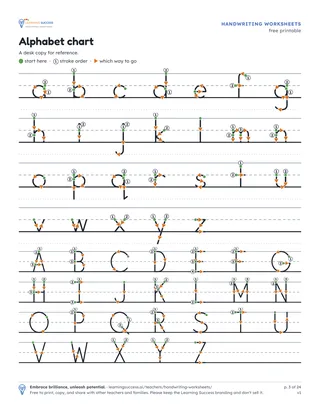
Letter pages for every lowercase letter and capital, grouped by how the letter starts. Each model letter shows a start dot, numbered strokes and arrows. There is also an alphabet chart, a progress check, lined paper and name practice pages.
How to teach a letter with the worksheets
These steps are ours.
- Show the letter on the board. Say where it starts and which way it goes.
- The student traces the model. Start at the dot. Follow the arrows.
- The student copies it.
- The student writes it once with the model covered.
- The student circles their best one and says why.
Then use the letter in a short word.
Letter families
The pages group letters that start the same way. For example, c, a, d, g, o and q all start with the same curve.
In our view, practice one family at a time, over several short sittings.
The grouping in the pack may differ from the one your class uses. Check it against the letters you teach.
Our page on handwriting activities has more letter families to practice. It is in the Read next links.
Name practice
Use the template for the student's own name. Say where each letter starts. Then the student writes their name.
When a student is still stuck
Watch the student form the letter, not just the finished letter. Look at where it starts.
Go back to tracing for that letter, then copying.
Keep the sittings short.
Our page on saying the letter as you write it shows how to talk through each stroke. It is in the Read next links.
If a student is still stuck after steady practice, raise it with your school team. Describe what you see. Do not name a condition.
Common questions from parents
Are the handwriting worksheets free?
Yes. The letter pages and name template are a free PDF. There is no email form. You can print them for your class.
Which print style do the worksheets use?
The pack uses one print style. Check it against the style your class uses.
Which letters should students learn first?
In our view, start with one family, like c, a, d, g, o and q. They all start with the same curve.
Should students do hand exercises before writing?
Keep any hand or finger exercise alongside handwriting practice, not in place of it. Handwriting improves most consistently with handwriting practice; motor work alone has not been shown to improve it.
Where these ideas come from
A 2012 federal guide on teaching writing gives steps for handwriting (Graham and colleagues). It says to show each letter with numbered arrows. Then students write the letter from memory. Practice comes in short, frequent sessions. Then students use the letters in real sentences.
The guide grades its advice on handwriting, spelling, sentences and typing together. The grade is moderate. That grade is for the advice as a whole, not for each step in it.
One review looked at help for school-age children with handwriting trouble (Hoy and colleagues, 2011). Help that left out handwriting practice did not work. Neither did help with too few practice sessions. The review does not say how much practice is enough.
Handwriting improves most consistently with handwriting practice; motor work alone has not been shown to improve it.
We hold no study that tests teaching letters in groups that start the same way. That is not the same as being shown not to work.
Free resources you can share with families
Everything below is free. Each one is written for parents.
Screeners
- Dyslexia screener — Questions for parents about what they have noticed with reading.
- Dyscalculia screener — Questions for parents about what they see with math at home.
- Dysgraphia screener — Questions about handwriting, spelling and writing at home.
- Attention & Executive Function screener — Questions about attention, getting started and finishing.
- Learning Difficulties Analysis — One set of questions across reading, writing, spelling and math.
Our rule is to say this wherever we name a screener. It is worth passing on: "A screener is a starting point, not a diagnosis. If your child might need formal accommodations (an IEP or 504 plan), or you suspect a vision, hearing, or medical cause, pursue a professional evaluation too — that's the only route to those supports."
Reading and courses for parents
- Focus Foundations — Our free e-book and parent community for working on focus.
- The Overly Emotional Child — A free course for parents on big feelings over schoolwork.
- Growth Mindset program — A free program on effort, practice and confidence.
- The Weekly Blueprint — Practical help for parents, every week by email.
- All free resources — Downloads and free programs in one place.