
IEP Data Sheets: Free Goal Tracking and Progress Monitoring Forms
IEP data sheets are forms for tracking how a student does on an IEP goal. This free pack has trial-by-trial, percent, frequency and rubric sheets, plus a graph. No sheet is tied to one goal. You write the goal in. It is a free PDF with an editable version and no email form.
TL;DR
- IEP data sheets are forms for tracking how a student does on an IEP goal.
- The pack has trial-by-trial, percent, frequency and rubric sheets, plus a graph.
- The sheets are for writing down how a student does on a goal, each time you check it.
- Keep the check short and the same each time.
- Free PDF plus an editable version. No email form.
An IEP data sheet is a form for tracking an IEP goal. You write down how a student does each time you check the goal.
”IEP data sheetWhat is in the IEP data sheets pack?
The sheets are for writing down how a student does on a goal, each time you check it.
- Trial-by-trial sheet. A trial-by-trial sheet is for marking each try at a skill.
- Percent sheet. A percent sheet is for the share of tries done right.
- Frequency sheet. A frequency sheet is for counting how many times something happens.
- Rubric sheet. A rubric sheet is for rating how well a piece of work is done.
- Graph. The graph is for showing the scores over time.
No sheet is tied to one goal. You write the goal in.
It comes as a PDF and as an editable version. Pages come in color and in black and white.
Free download: IEP data sheets
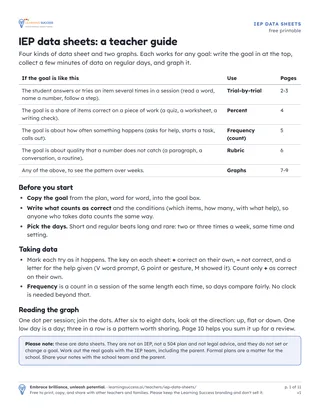
Trial-by-trial, percent, count and rubric sheets, each with a goal block at the top. There are percent and count graphs, a worked example and a progress review page.
Which sheet fits which goal?
In our view, match the sheet to the way the goal is written. For example:
- A goal with "8 of 10 tries" fits a trial-by-trial or percent sheet.
- A goal about how often a behavior happens fits a frequency sheet.
- A goal about the quality of writing fits a rubric sheet.
How to take data on a goal
These steps are ours.
- Copy the goal from the IEP word for word.
- Check on the same day each week or two.
- Keep the check short and the same each time.
- Write down the date and the score.
- Add the score to the graph.
A filled-in form holds private details about a student. Keep it safe.
Share the data the way your school allows.
Reading the graph
Look back at the graph on a set day. Each score shows how the student did on that check.
If the scores stay flat, talk with the team about what to change. Before you change the help, check how the student does on more than one day.
What the data sheets are not
The data sheets are a place to write down scores. They do not replace the IEP.
The data sheets do not say what any student is owed. They are not legal advice. Formal plans are a matter for the school.
Our IEP goal bank has goal examples. It is in the Read next links.
Common questions from parents
Are the IEP data sheets free?
Yes. They are a free PDF with an editable version. There is no email form. Share the blank PDF with other teachers and families. Keep the editable file for your own class.
How often should I take data?
In our view, check on the same day each week or two. Keep the check the same each time. Agree on the plan with your school team.
What is the difference between percent and frequency data?
Percent data shows the share of tries done right. Frequency data counts how many times something happens.
Can I use these sheets for behavior goals?
Yes. A frequency sheet is for counting how often a behavior happens. You can also write down what happens before and after the behavior. Our page on ABC data sheets shows how. It is in the Read next links.
How many scores do I need before I change the help?
This page gives no target number. Talk it over with your school team.
Where these ideas come from
One review pooled 14 studies of help adjusted to each student's progress (Jung and colleagues, 2018). Help adjusted this way improved results "across academic areas". We could read only its summary.
We hold no study that tests these data sheets or the graph. We also hold no study that compares one kind of data sheet with another. That is not the same as being shown not to work.
Free resources you can share with families
Everything below is free. Each one is written for parents.
Screeners
- Dyslexia screener — Questions for parents about what they have noticed with reading.
- Dyscalculia screener — Questions for parents about what they see with math at home.
- Dysgraphia screener — Questions about handwriting, spelling and writing at home.
- Attention & Executive Function screener — Questions about attention, getting started and finishing.
- Learning Difficulties Analysis — One set of questions across reading, writing, spelling and math.
Our rule is to say this wherever we name a screener. It is worth passing on: "A screener is a starting point, not a diagnosis. If your child might need formal accommodations (an IEP or 504 plan), or you suspect a vision, hearing, or medical cause, pursue a professional evaluation too — that's the only route to those supports."
Reading and courses for parents
- Focus Foundations — Our free e-book and parent community for working on focus.
- The Overly Emotional Child — A free course for parents on big feelings over schoolwork.
- Growth Mindset program — A free program on effort, practice and confidence.
- The Weekly Blueprint — Practical help for parents, every week by email.
- All free resources — Downloads and free programs in one place.