
The 6 Syllable Types: Free Chart and Word Lists
The six syllable types sort syllables by how they are spelled. This free pack has an anchor chart of the six types. It also has word lists for each type and a sort. It is for teaching the types and practicing each one. It is a free PDF with no email form.
TL;DR
- A syllable type is a group of syllables spelled the same kind of way.
- The pack has an anchor chart, word lists for each type, and a sort.
- The pack is for teaching the six types and practicing each one.
- Teach one type at a time. Read its words aloud together.
- Free PDF, no email form.
A syllable type is a group of syllables spelled the same kind of way. The type often points to the vowel sound.
”syllable typeWhat is in the syllable types pack?
The pack is for teaching the six types and practicing each one.
- An anchor chart of the six syllable types
- Word lists for each type
- A sort
Pages come in color and in black and white.
Free download: Syllable types pack
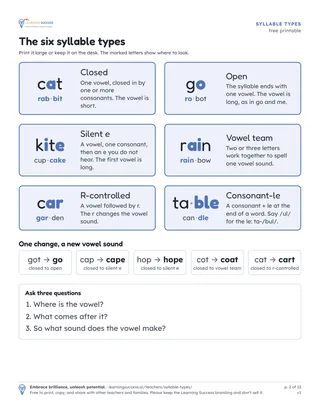
An anchor chart of the six syllable types and a page on splitting longer words. There are word lists, four card sorts, two practice pages and an answer key. A short teacher guide and a note for home are included.
The six syllable types
Closed. The syllable has one vowel and ends in a consonant. The vowel is often short, like nap in napkin.
Open. The syllable has one vowel, at the end. The vowel often says its name, like ro in robot.
Silent e. A vowel, then a consonant, then an e. The e is silent, and the vowel often says its name, like cake in cupcake.
Vowel team. Two or more letters spell one vowel sound. In rainbow, ai spells the vowel in rain.
Vowel-r. A vowel is followed by r in the same syllable. The r changes the vowel sound, like gar in garden. Another name for this is an r-controlled vowel.
Consonant-le. A consonant, then le, often at the end of a word, like ble in table.
These patterns often hold, but not every time. When a word does not fit, say so and read it together.
Our page on reading long words shows how to read a word one part at a time. It is in the Read next links.
How to teach the syllable types
These steps are ours.
- Teach one type at a time. Point to it on the chart.
- Read that type's word list aloud together.
- The student finds the vowel and says the syllable.
- Once the student knows two types, use the sort to tell them apart.
- Move on when the student reads a type steadily. Check it on more than one day.
When a student is still stuck
Go back to closed syllables. Practice those again.
Our page on CVC words has word lists for each short vowel. It is in the Read next links.
Use fewer words at a sitting.
Read one part at a time. Then put the parts together.
If a student is still stuck after steady practice, raise it with your school team. Describe what you see. Do not name a condition.
Common questions from parents
Are the syllable types chart and word lists free?
Yes. The chart, word lists and sort are a free PDF. There is no email form. You can print them for your class.
What are the six syllable types?
The six types are closed, open, silent e, vowel team, vowel-r and consonant-le.
Do students need to learn the names of the types?
In our view, no. Reading the part matters more than naming its type.
Which type should students learn first?
In our view, start with closed syllables, like nap in napkin. Then add open syllables, like ro in robot.
Where these ideas come from
A federal reading guide came out in 2016 (Foorman and colleagues). It is not a guide to dyslexia. Almost all its studies were done in schools, not at home.
It recommends teaching students to decode words. Its steps include common spelling patterns and the six syllable types. It rates the evidence for that advice as strong. That grade is for the advice as a whole, not for each step in it.
It names the six types: closed, silent e, open, vowel team, vowel-r and consonant-le. It gives no set of rules for splitting words.
We hold no study that tests a syllable types chart or word lists by type. That is not the same as being shown not to work.
Free resources you can share with families
Everything below is free. Each one is written for parents.
Screeners
- Dyslexia screener — Questions for parents about what they have noticed with reading.
- Dyscalculia screener — Questions for parents about what they see with math at home.
- Dysgraphia screener — Questions about handwriting, spelling and writing at home.
- Attention & Executive Function screener — Questions about attention, getting started and finishing.
- Learning Difficulties Analysis — One set of questions across reading, writing, spelling and math.
Our rule is to say this wherever we name a screener. It is worth passing on: "A screener is a starting point, not a diagnosis. If your child might need formal accommodations (an IEP or 504 plan), or you suspect a vision, hearing, or medical cause, pursue a professional evaluation too — that's the only route to those supports."
Reading and courses for parents
- Focus Foundations — Our free e-book and parent community for working on focus.
- The Overly Emotional Child — A free course for parents on big feelings over schoolwork.
- Growth Mindset program — A free program on effort, practice and confidence.
- The Weekly Blueprint — Practical help for parents, every week by email.
- All free resources — Downloads and free programs in one place.