
Sight Word Lists by Grade: Free Dolch and Fry Lists
Sight words are words a student reads straight away, without sounding them out. This free pack has Dolch and Fry word lists, grouped by grade. It also has flash cards and a tracking sheet. The tricky parts of words are marked with a heart. It is a free PDF with no email form.
TL;DR
- Sight words are words a student reads straight away, without sounding them out.
- The pack has the Dolch and Fry word lists. It also has flash cards and tracking sheets.
- Use the lists to teach a few words at a time. Track which ones a student reads at once.
- Sound out the parts that follow the patterns. The heart marks the tricky part.
- Free PDF, no email form.
Sight words are words a student reads straight away, without sounding them out. The name also covers lists of common words, like the Dolch and Fry lists.
”sight wordsWhat is in the sight word pack?
The pack is for teaching common words a few at a time. It also lets you keep track of each word.
- Dolch word lists, grouped by level.
- Fry word lists, in groups of 100.
- Flash cards for short practice rounds.
- Tracking sheets to mark the words a student reads at once.
- Heart marks. The tricky part of a word is marked with a heart.
Pages come in color and in black and white.
Free download: Sight word lists and flash cards
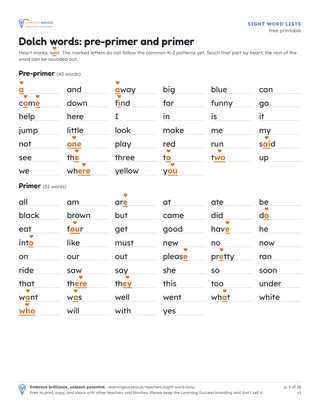
The Dolch and Fry word lists, with heart marks on the tricky parts. There is a mapping page, tracking sheets and 452 flash cards.
How we teach a sight word
Sounding out is the only way to handle a word a student has never seen. So we sound out what we can, even in a sight word.
- Read the word to the student. "Said."
- Sound out the parts that follow the patterns. In said, the s and the d sound as expected.
- Mark the tricky part with a heart. In said, the ai says /e/. Say it and point to the heart.
- Write the word. Say each sound as you write it.
- Practice with flash cards. Keep rounds short. Mix a few new words with known ones.
- Fill in the tracking sheet. Mark each word the student reads at once.
Some list words follow the patterns, like and, can and big. Teach those by sounding them out. Some words do not follow the patterns a student knows. In our view, those are taught as whole words, alongside phonics.
Our page on sight word recognition says how sight words fit with sounding out. It is in the Read next links.
Keeping track
The tracking sheet shows which words a student knows. A word counts when the student reads it at once. Check it on more than one day before you mark it as known.
Keep only a few new words going at once. When one is known, add the next one.
When a student is still stuck
If letter sounds are still shaky, go back to those first. Our page of phonics activities has games for that step. It is in the Read next links.
If a student cannot yet sound out a short word like cat, start there. Our page of CVC word activities has games for it. It is in the Read next links.
Some students need more practice with a word before they know it. Give those words more short rounds. Keep the set small.
If a student is still stuck after steady practice, raise it with your school team. Describe what you see. Do not name a condition.
Common questions from parents
Are the sight word lists free?
Yes. The word lists and flash cards are a free PDF. There is no email form. You can print them for your class.
Should I use the Dolch list or the Fry list?
Use the list your school already uses. That way, the words match what the student sees in class.
What are heart words?
A heart word has a part that does not follow the patterns a student knows yet. In the pack, that part is marked with a heart. The student learns that part by heart.
How are the lists grouped?
The Dolch lists are grouped by level, as Dolch grouped them. The Fry lists come in groups of 100, in their published order. Each list is a set of words to teach a few at a time.
Where these ideas come from
A federal reading guide came out in 2016 (Foorman and colleagues). It recommends teaching common words until students read them at once. That covers words that follow the patterns and words that do not. It rates the evidence for that advice as strong. Flash cards, a word wall and short timed rounds are its examples. Those are the guide's examples, not a tested method on its own.
One small study compared beginning readers with older readers who struggled (Ehri and Saltmarsh, 1995). The older readers took more tries to learn the same words.
We hold no study that compares the Dolch list with the Fry list. We also hold no study of marking the tricky part of a word with a heart. That is not the same as being shown not to work.
Free resources you can share with families
Everything below is free. Each one is written for parents.
Screeners
- Dyslexia screener — Questions for parents about what they have noticed with reading.
- Dyscalculia screener — Questions for parents about what they see with math at home.
- Dysgraphia screener — Questions about handwriting, spelling and writing at home.
- Attention & Executive Function screener — Questions about attention, getting started and finishing.
- Learning Difficulties Analysis — One set of questions across reading, writing, spelling and math.
Our rule is to say this wherever we name a screener. It is worth passing on: "A screener is a starting point, not a diagnosis. If your child might need formal accommodations (an IEP or 504 plan), or you suspect a vision, hearing, or medical cause, pursue a professional evaluation too — that's the only route to those supports."
Reading and courses for parents
- Focus Foundations — Our free e-book and parent community for working on focus.
- The Overly Emotional Child — A free course for parents on big feelings over schoolwork.
- Growth Mindset program — A free program on effort, practice and confidence.
- The Weekly Blueprint — Practical help for parents, every week by email.
- All free resources — Downloads and free programs in one place.