
IEP Goal Bank: Free Goal Examples for Reading, Writing, Math and Behavior
This is a free bank of IEP goal examples for K-5. It covers reading, writing, math and behavior. Each goal says what the student will do, how well, and how you will check it. Copy a goal, then change it to fit your student. Set the real goals with the IEP team, including the parent. The bank is a free PDF with an editable Word version. There is no email form.
TL;DR
- Free IEP goal examples for K-5: reading, writing, math and behavior.
- Every goal follows one shape: who, does what, how well, checked how, by when.
- Each one is a starting point. Change it to fit the student in front of you.
- Set the real goals with the IEP team. This bank does not say what any student is owed.
- Free PDF, plus an editable Word version. No email form.
An IEP goal is a target written into a student's plan for the year. A useful goal says what the student will do and how anyone can check it.
”IEP goalWhat is in the goal bank?
The bank has four sections.
- Reading. Sounds, sounding out, sight words, reading speed and understanding.
- Writing. Letter forming, spelling, sentences and short paragraphs.
- Math. Counting, number sense, facts, place value and word problems.
- Behavior. Starting work, staying with a task, asking for help and calming down.
Each section starts with the early skills and moves up. Each goal has a line on how to check it. There is also a blank goal sheet, so you can write your own in the same shape.
Free download: IEP goal bank
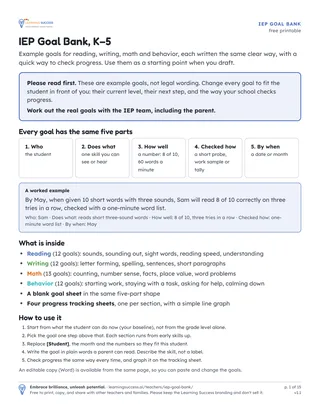
49 example goals for reading, writing, math and behavior. Each has a way to check it. There is also a blank goal sheet and progress graphs.
The shape every goal follows
Every goal in the bank has five parts.
- Who. The student.
- Does what. One skill you can see or hear.
- How well. For example, 8 of 10, or 60 words a minute.
- Checked how. A short probe, a work sample or a tally.
- By when. A date or a month.
Here is one example from the reading section. By May, when given 10 short words with three sounds, Sam will read 8 of 10 correctly on three tries in a row, checked with a one-minute word list.
This shape is general practice. We hold no study that compares one way of writing goals with another.
How to change a goal to fit your student
Start from what the student can do now. A goal that starts too high is hard to meet and hard to track.
- Change the skill to the next small step.
- Change the number. Base it on two or three checks you have done.
- Change the check to something you already do in class.
- Keep it to one skill. A goal with two skills in it is hard to score.
If you are not sure where the student is, check first. A one-minute word list or a short math probe gives you a number to start from.
Who decides the goals?
Work out the real goals with the IEP team, including the parent. This bank is a set of examples. It does not say what any student is owed, and it is not legal advice.
Tracking progress on a goal
A goal is only useful if someone checks it. Keep the check short and the same each time.
- Check on the same day each week or two.
- Write down the date and the score.
- Draw a simple line graph. If the line stays flat, talk with the team about what to change.
The bank has a one-page tracking sheet for each section.
Common questions from parents
Is this IEP goal bank free?
Yes. It is a free PDF with an editable Word version. There is no email form. Share the PDF with other teachers and families. Keep the Word file for your own class.
Are these goals legally approved?
No. The goals are examples, not legal wording. Work out the real goals with the IEP team, including the parent. This bank does not say what any student is owed.
What grades does the goal bank cover?
The goals are written for kindergarten to grade 5. Start from what the student can do now, not grade alone.
Is there research behind this way of writing goals?
The shape on this page is general practice. We hold no study that compares one way of writing goals with another.
Free resources you can share with families
Everything below is free. Each one is written for parents.
Screeners
- Dyslexia screener — Questions for parents about what they have noticed with reading.
- Dyscalculia screener — Questions for parents about what they see with math at home.
- Dysgraphia screener — Questions about handwriting, spelling and writing at home.
- Attention & Executive Function screener — Questions about attention, getting started and finishing.
- Learning Difficulties Analysis — One set of questions across reading, writing, spelling and math.
Our rule is to say this wherever we name a screener. It is worth passing on: "A screener is a starting point, not a diagnosis. If your child might need formal accommodations (an IEP or 504 plan), or you suspect a vision, hearing, or medical cause, pursue a professional evaluation too — that's the only route to those supports."
Reading and courses for parents
- Focus Foundations — Our free e-book and parent community for working on focus.
- The Overly Emotional Child — A free course for parents on big feelings over schoolwork.
- Growth Mindset program — A free program on effort, practice and confidence.
- The Weekly Blueprint — Practical help for parents, every week by email.
- All free resources — Downloads and free programs in one place.