
Hundreds Chart: Free Printable Charts and Activities
A hundreds chart shows the numbers 1 to 100 in rows of ten. Students use it to count, find patterns and see the tens. This free pack has filled, blank and partly filled charts. It also has activities that use the chart. It is a free PDF with no email form.
TL;DR
- A hundreds chart shows the numbers 1 to 100 in rows of ten.
- The pack has filled, blank and partly filled charts. It also has activities that use the chart.
- The 10s all sit in one column, so students can see the tens.
- Count on from a number, not always from 1.
- Free PDF, no email form.
A hundreds chart is a grid of the numbers 1 to 100. It has ten rows of ten. Each row starts one ten higher than the last.
”hundreds chartWhat is in the hundreds chart pack?
The pack is for counting, finding patterns and seeing the tens.
- A filled chart from 1 to 100.
- A blank chart for the student to fill in.
- Partly filled charts with gaps to fill.
- Activities that use the chart.
Pages come in color and in black and white.
Free download: Hundreds charts
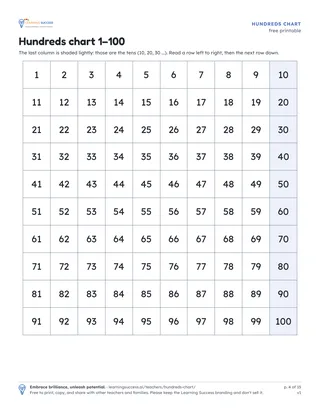
A filled chart, a blank chart and three missing-number charts. There are 10 activities, a chart puzzle, arrow paths and an answer key.
Ways to use a hundreds chart
These routines are ours.
- Color the 5s and the 10s. Color 5, 10, 15 and on to 100. Look at the pattern the colors make. Then circle 10, 20, 30 in a new color. Ask what the student sees. The 10s all sit in one column.
- Count by 10s down a column. Start at 4. Count by 10s: 4, 14, 24. Those numbers run straight down one column.
- Count back by 10s. Start at 90. Count back by 10s: 90, 80, 70. The student moves up the column.
- Fill in the gaps. On a partly filled chart, fill in the missing numbers. Ask how the student knew each one.
- Count on. Pick a number, like 46. Ask what comes 3 later. The student starts at 46 and counts on: "47, 48, 49."
Our page on skip counting has more ways to use a hundreds chart. It is in the Read next links.
Counting with cubes
For counting with cubes, try our Build It, Count It book. Students guess, build and count cube puzzles, beside your math lessons. Each puzzle ends with how many more cubes make the next ten.
When a student is still stuck
If counting is still shaky, go back to counting objects one by one. Touch each one as you say its number.
If the whole chart is too much, use a smaller part of it, like 1 to 20. Cover the rest. Add rows as the student is ready.
Our page on number board games covers games on a board in rows of ten. It is in the Read next links.
If a student is still stuck after steady practice, raise it with your school team. Describe what you see. Do not name a condition.
Common questions from parents
Is the hundreds chart free?
Yes. The charts and activities are a free PDF. There is no email form. You can print them for your class.
Should a hundreds chart start at 0 or 1?
This pack's charts go from 1 to 100. Some charts start at 0 instead. Use the one your class uses.
How is a hundreds chart different from a number line?
A number line puts the numbers in one long row. A hundreds chart breaks them into rows of ten.
Where these ideas come from
A 2021 federal guide on extra math help gives examples of skip counting (Fuchs and colleagues). They use a number line or a hundreds chart. These are the panel's examples. Skip counting was not a tested topic in the guide.
One trial used a game board from 0 to 100, in rows of ten (Laski and Siegler, 2014). The players were kindergartners. Some were taught to count on from their square: "6, 7." Others counted from 1 each turn. The kindergartners who counted on learned more.
We hold no study that tests a hundreds chart on its own. That is not the same as being shown not to work.
Free resources you can share with families
Everything below is free. Each one is written for parents.
Screeners
- Dyslexia screener — Questions for parents about what they have noticed with reading.
- Dyscalculia screener — Questions for parents about what they see with math at home.
- Dysgraphia screener — Questions about handwriting, spelling and writing at home.
- Attention & Executive Function screener — Questions about attention, getting started and finishing.
- Learning Difficulties Analysis — One set of questions across reading, writing, spelling and math.
Our rule is to say this wherever we name a screener. It is worth passing on: "A screener is a starting point, not a diagnosis. If your child might need formal accommodations (an IEP or 504 plan), or you suspect a vision, hearing, or medical cause, pursue a professional evaluation too — that's the only route to those supports."
Reading and courses for parents
- Focus Foundations — Our free e-book and parent community for working on focus.
- The Overly Emotional Child — A free course for parents on big feelings over schoolwork.
- Growth Mindset program — A free program on effort, practice and confidence.
- The Weekly Blueprint — Practical help for parents, every week by email.
- All free resources — Downloads and free programs in one place.