
First-Then Boards: Free Printable Templates and Cards
A first-then board shows two steps in order. First comes a task. Then comes something the student wants, or the next part of the day. This free pack has a first-then board and cards for tasks and rewards. It is a free PDF with no email form.
TL;DR
- A first-then board shows a task, then what comes after it.
- The pack: a first-then board, plus task and reward cards.
- It shows the student what comes after the task.
- Keep the "first" task short and clear.
- Free PDF, no email form.
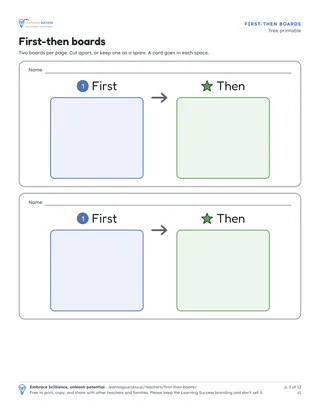
A first-then board is a card with two boxes. The "first" box shows a task. The "then" box shows what comes after it.
”first-then boardWhat is in the first-then board pack?
The board shows the student what comes after the task.
- A first-then board. A card with a "first" box and a "then" box.
- Task and reward cards. Cards for the "first" box and the "then" box.
- Other boards. A first-next-then board, a now-and-later board and choice strips.
Pages come in color and in black and white.
Free download: First-then boards
First-then, first-next-then and now-and-later boards, and choice strips. There are 40 picture cards for tasks and rewards, plus blank cards.
How to use a first-then board
- Put a task card in "first." Pick one short, clear task. Say what to do, not what to stop.
- Where you can, let the student pick the "then" card.
- Say it once. For example: "First reading, then blocks."
- Give the "then" when the task is done.
- Clear the board. Then start the next pair.
The board is for one student. Keep it between you and the student.
Choosing the "then"
In our view, a reward can get a reluctant student started. We would not let it become the reason for the work.
The "then" can also be the next part of the day, like lunch.
In our view, a first-then board is for a task the student avoids. We would not use one for work the student already enjoys.
Our page on why motivation disappears covers what research found about rewards. It is in the Read next links.
When a student is still stuck
If the student does not start, make the "first" task shorter. Check that the student still wants the "then" card. Let them pick a new card if not.
You can also write down what happens before and after the behavior. Our page on ABC data sheets shows how. It is in the Read next links.
If the behavior keeps up after steady use of the board, raise it with your school team. Describe what you see. Do not name a condition.
Common questions from parents
Are the first-then boards free?
Yes. The boards and cards are a free PDF. There is no email form. You can print them for your class.
What goes in the "then" box?
Something the student wants, or the next part of the day. For a reward, ask the student what they want to work for.
Is a first-then board a visual schedule?
In our view, it is a short one, with two steps. A visual schedule can show many more steps.
Should the reward always be the same?
No. Let the student pick a new one when they want.
Where these ideas come from
Deci, Koestner and Ryan (1999) pooled 128 experiments on rewards and motivation. They found tangible rewards for doing a task undermined people's own motivation for tasks they already engaged with. Eisenberger, Pierce and Cameron argued that the effect is narrower. In their view, verbal praise and unexpected rewards do not undermine a person's own motivation. They also argued a reward can help on a task of little interest to begin with.
We hold no study that tests a first-then board. That is not the same as being shown not to work.
Free resources you can share with families
Everything below is free. Each one is written for parents.
Screeners
- Dyslexia screener — Questions for parents about what they have noticed with reading.
- Dyscalculia screener — Questions for parents about what they see with math at home.
- Dysgraphia screener — Questions about handwriting, spelling and writing at home.
- Attention & Executive Function screener — Questions about attention, getting started and finishing.
- Learning Difficulties Analysis — One set of questions across reading, writing, spelling and math.
Our rule is to say this wherever we name a screener. It is worth passing on: "A screener is a starting point, not a diagnosis. If your child might need formal accommodations (an IEP or 504 plan), or you suspect a vision, hearing, or medical cause, pursue a professional evaluation too — that's the only route to those supports."
Reading and courses for parents
- Focus Foundations — Our free e-book and parent community for working on focus.
- The Overly Emotional Child — A free course for parents on big feelings over schoolwork.
- Growth Mindset program — A free program on effort, practice and confidence.
- The Weekly Blueprint — Practical help for parents, every week by email.
- All free resources — Downloads and free programs in one place.