
Functional Behavior Assessment (FBA) Template: Free Forms
A functional behavior assessment (FBA) is a close look at one behavior. It gathers when the behavior happens, and what comes before and after it. This free pack has a teacher interview form and a summary form. The forms are for gathering what the team has seen about one behavior. It is a free PDF with no email form.
TL;DR
- An FBA is a close look at one behavior. It notes when the behavior happens, and what comes before and after.
- The pack has a teacher interview form and a summary form.
- The forms are for gathering what the team has seen about one behavior.
- Write what you see, not a guess at why.
- Free PDF, no email form.
A functional behavior assessment (FBA) is a close look at one behavior. It gathers when the behavior happens, what comes just before it, and what comes just after.
”functional behavior assessmentWhat is in the FBA pack?
The pack is for gathering what the team knows about one behavior.
- A teacher interview form.
- A summary form.
The forms are made to go with our ABC data sheets. Our page on ABC data sheets shows how to take notes on a behavior. It is in the Read next links.
Pages come in color and in black and white.
Free download: FBA template
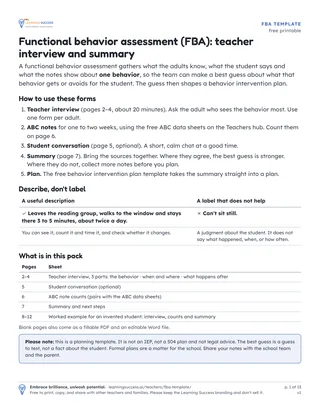
A teacher interview, an optional student talk, a page to count ABC notes and a one-page summary. A worked example shows every page filled in.
How to use the FBA forms
These steps are ours.
- Pick one behavior. Describe it so two adults would agree.
- Take ABC notes over several days. Write each note soon, while you still remember.
- Use the interview form. Write down what the teacher has seen.
- Bring it together. Put the notes and the interview together on the summary form.
- Share the summary with your school team.
Use one set of forms for each student. In our view, they should be kept private, not posted for the class.
Describing a behavior: examples
A good description says what you saw and heard. Two adults who read it would picture the same thing.
- "Leaves seat during math" is clearer than "off task".
- "Calls out answers during group reading" is clearer than "disruptive".
- "Put head on desk when the worksheet was handed out" is a note. "Was lazy" is a judgment.
Write what you see, not a guess at why. Words like "lazy" or "rude" are judgments. They do not say what happened.
Reading the summary
When the notes and the interview are together, look across them.
- Does the behavior happen at the same time of day, or in the same subject?
- Does it start when work is handed out, or when a task gets hard?
- What usually happens next?
If you see a pattern, note it for your team.
The summary is a starting point for your team. It is not a diagnosis.
When a student is still stuck
Check that everyone describes the behavior the same way. If not, agree on one description first.
Add notes from another time of day or another subject.
If a behavior puts anyone at risk, follow your school's safety steps the same day.
If the behavior keeps up, bring your notes back to your school team. Describe what you see. Do not name a condition.
Common questions from parents
Are the FBA forms free?
Yes. The interview and summary forms are a free PDF. There is no email form. You can print them for your team.
Do I need ABC data first?
In our view, yes. ABC notes give the interview and summary something to work from.
How long should we collect notes?
In our view, collect notes over several days, not one bad day.
What makes a good behavior description?
Write what you saw and heard. Two adults who read your words should picture the same thing.
Where these ideas come from
The ideas on this page are ours. We hold no study of functional behavior assessment or these forms. So no study we hold tests these ideas. That is not the same as being shown not to work.
Free resources you can share with families
Everything below is free. Each one is written for parents.
Screeners
- Dyslexia screener — Questions for parents about what they have noticed with reading.
- Dyscalculia screener — Questions for parents about what they see with math at home.
- Dysgraphia screener — Questions about handwriting, spelling and writing at home.
- Attention & Executive Function screener — Questions about attention, getting started and finishing.
- Learning Difficulties Analysis — One set of questions across reading, writing, spelling and math.
Our rule is to say this wherever we name a screener. It is worth passing on: "A screener is a starting point, not a diagnosis. If your child might need formal accommodations (an IEP or 504 plan), or you suspect a vision, hearing, or medical cause, pursue a professional evaluation too — that's the only route to those supports."
Reading and courses for parents
- Focus Foundations — Our free e-book and parent community for working on focus.
- The Overly Emotional Child — A free course for parents on big feelings over schoolwork.
- Growth Mindset program — A free program on effort, practice and confidence.
- The Weekly Blueprint — Practical help for parents, every week by email.
- All free resources — Downloads and free programs in one place.