
Check-In Check-Out (CICO): Free Daily Point Sheets
Check-In Check-Out (CICO) is a daily routine. A student checks in with an adult each morning. They carry a point sheet through the day, then check out. This free pack has a daily point sheet, a weekly graph and a fading plan. It is for tracking one student's goals. It is a free PDF with no email form.
TL;DR
- Check-in check-out is a daily routine: a morning check-in, a point sheet, and an end-of-day check-out.
- The pack has a daily point sheet and a weekly graph. It also has a plan page for stepping the routine down.
- The pack is for tracking one student's goals through the day.
- The sheet is for one student. It is kept private.
- Free PDF, no email form.
Check-in check-out is a daily routine. A student meets an adult at the start of the day to check in. They carry a point sheet for their goals. At the end of the day, they meet the same adult to check out.
”check-in check-outWhat is in the check-in check-out pack?
The pack is for tracking one student's goals through the day.
- Daily point sheet. A sheet for the student's goals through the day.
- Weekly graph. A page for looking back over the week.
- A fading plan. A page for stepping the routine down.
Pages come in color and in black and white.
Free download: Check-in check-out pack
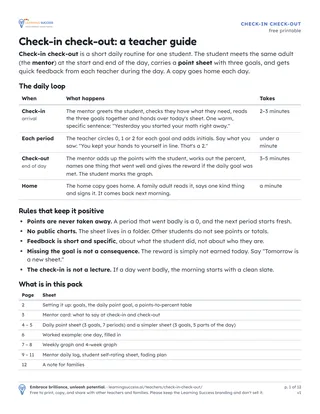
A daily point sheet with three goals, plus a simpler version for younger students. There are weekly and 4-week graphs, a set-up page and a mentor card. A home copy goes back and forth each day.
How to run check-in check-out
These steps are ours.
- Choose the goals together. Say what to do, not what to stop. "Raise a hand to talk" is clearer than "no calling out".
- Let the student pick the reward. Agree on it before you start.
- Check in each morning. Go over the goals, and hand over the sheet.
- Mark the sheet through the day. Mark the sheet soon after you see the behavior. Name what the student did.
- Check out at the end of the day. Look at the sheet together. Say what went well.
- Look back over the week on the weekly graph.
The sheet is for one student. Keep it between you, the student and the adults who mark it.
Stepping the reward down
In our view, a reward can get a reluctant student started. We would not let it become the reason for the work.
So plan from the start how the reward will step down. The plan page steps the routine down, one part at a time.
In our view, a point sheet is for a goal the student finds hard. We would not use one for something the student already does gladly.
When a student is still stuck
Check the goals first. A goal may be too big for one day. Try a smaller goal the student can meet.
Check that the student still wants the reward. Let them pick a new one if not.
Our token board pack has boards for one task at a time. It is in the Read next links.
You can also write down what happens before and after the behavior. Our page on ABC data sheets shows how. It is in the Read next links.
If the behavior keeps up after steady use of the sheet, raise it with your school team. Describe what you see. Do not name a condition.
Common questions from parents
Are the check-in check-out sheets free?
Yes. The point sheet, weekly graph and plan page are a free PDF. There is no email form. You can print them for your class.
Who should do the check-in?
In our view, one adult the student gets on with. Meet at the same time each day. It does not have to be the class teacher.
Do rewards hurt motivation?
Tangible rewards can, on tasks people already engage with. Deci, Koestner and Ryan (1999) found tangible rewards lowered people's own motivation. That was on tasks they already engaged with. Others argue praise and unexpected rewards do not lower it (Eisenberger, Pierce and Cameron). In our view, save rewards for a task the student avoids.
When should check-in check-out stop?
In our view, plan the end from the start. Step the reward down as the student meets the goals steadily. The plan page steps the routine down, one part at a time.
Where these ideas come from
Deci, Koestner and Ryan (1999) pooled 128 experiments on rewards and motivation. They found tangible rewards for doing a task undermined people's own motivation for tasks they already engaged with. Eisenberger, Pierce and Cameron argued that the effect is narrower. In their view, verbal praise and unexpected rewards do not undermine a person's own motivation. They also argued a reward can help on a task of little interest to begin with.
Stepping a reward down over time is common practice. We hold no study that tests it.
We hold no study of Check-In Check-Out. We also hold no study that tests a point sheet on its own. That is not the same as being shown not to work.
Free resources you can share with families
Everything below is free. Each one is written for parents.
Screeners
- Dyslexia screener — Questions for parents about what they have noticed with reading.
- Dyscalculia screener — Questions for parents about what they see with math at home.
- Dysgraphia screener — Questions about handwriting, spelling and writing at home.
- Attention & Executive Function screener — Questions about attention, getting started and finishing.
- Learning Difficulties Analysis — One set of questions across reading, writing, spelling and math.
Our rule is to say this wherever we name a screener. It is worth passing on: "A screener is a starting point, not a diagnosis. If your child might need formal accommodations (an IEP or 504 plan), or you suspect a vision, hearing, or medical cause, pursue a professional evaluation too — that's the only route to those supports."
Reading and courses for parents
- Focus Foundations — Our free e-book and parent community for working on focus.
- The Overly Emotional Child — A free course for parents on big feelings over schoolwork.
- Growth Mindset program — A free program on effort, practice and confidence.
- The Weekly Blueprint — Practical help for parents, every week by email.
- All free resources — Downloads and free programs in one place.