
Tier 2 Interventions: A Free List of Examples by Need
Tier 2 is extra help in a small group, on top of the teaching every student gets. This free pack has a menu of intervention ideas for reading, math, writing and behavior. It also has an intervention log. It is for choosing small-group help by need and keeping a record. It is a free PDF with no email form.
TL;DR
- Tier 2 is extra help in a small group, on top of the teaching every student gets.
- The pack has an intervention menu for reading, math, writing and behavior, and a log.
- The pack is for choosing small-group help by need, and keeping a record of it.
- Match the help to what the student needs. Teach the skill itself.
- Free PDF, no email form.
An intervention log is a running record of the extra help one student gets.
”intervention logWhat is in the tier 2 interventions pack?
The pack is for choosing small-group help by need, and keeping a record of it.
- A menu of intervention ideas for reading, math, writing and behavior.
- An intervention log.
Pages come in color and in black and white.
Free download: Tier 2 interventions pack
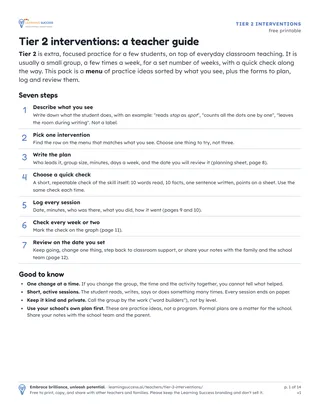
A plain guide to Tiers 1, 2 and 3 and a seven-step way to run a small group. The menu covers reading, math, writing and behavior, sorted by what you see in the student. Planning and record forms are included.
Tier 1, 2 and 3
Tier 1 is what every student gets. Tier 2 adds small-group help. Tier 3 is more intensive and more individual.
Examples by need
These examples are ours. Each reading, math and writing example is practice in the skill itself.
Reading
- Small-group practice with letter sounds and sounding out words.
- Rereading a short passage, with feedback on the words.
Our page on phonics activities has more ideas for letter sounds and words. It is in the Read next links.
Math
- Small-group practice with counting, place value or facts. Use it beside your math lessons, not in place of them.
- Showing a problem with objects, then a drawing, then numbers.
Our page on math activities goes skill by skill. It is in the Read next links.
Writing
- Short, regular practice forming letters.
- Building a sentence together, then writing it.
Behavior
- A daily check-in and check-out with an adult, with a point sheet.
- Practicing one class routine in a small group.
For behavior, you can also write down what happens before and after the behavior. Our page on ABC data sheets shows how. It is in the Read next links.
How to use the intervention log
These steps are ours.
- Pick one need for the student. Describe what you see.
- Choose help from the menu that teaches that skill.
- Write down the help each time you give it.
- Look back at the log on a set day. Before you change the help, check how the student does on more than one day.
Keep each student's log private.
For schools using MTSS
If your school or district is planning its tiers, see Learning Success for schools.
When a student is still stuck
Check the match first. The help may be for a different skill than the one the student needs.
Try a smaller step in the same skill.
If a student is still stuck after steady small-group help, raise it with your school team. Describe what you see. Do not name a condition.
Common questions from parents
Is the tier 2 interventions pack free?
Yes. The intervention menu and log are a free PDF. There is no email form. You can print them for your class.
What are some tier 2 interventions for reading?
We like small-group practice with letter sounds and sounding out words. We also like rereading a short passage, with feedback on the words. Start with the skill the student is missing.
What are some tier 2 math interventions?
One example we like is small-group practice with counting, place value or facts. Use it beside your math lessons, not in place of them.
What are tier 2 behavior interventions?
In our view, they are short, planned steps for one behavior goal. One example is a check-in and check-out with an adult each day.
Where these ideas come from
A 2021 federal guide covers extra math help (Fuchs and colleagues). It covers students who find math hard, or are likely to. It is about help in small groups or one to one, at school.
It rates the evidence for all six of its recommendations as strong. Those grades are for each recommendation as a whole, not for each step in it. Each of its studies tested a whole package of help.
A federal reading guide came out in 2016 (Foorman and colleagues). It is not a guide to dyslexia. Almost all its studies were done in schools, not at home.
It recommends teaching students to decode words and to read and write them. Most of the studies behind that advice gave help in small groups or one to one. It rates the evidence for that advice as strong. That grade is for the advice as a whole, not for each step in it.
We hold no study that tests an intervention menu or an intervention log. We also hold no study of small-group help for behavior. That is not the same as being shown not to work.
Free resources you can share with families
Everything below is free. Each one is written for parents.
Screeners
- Dyslexia screener — Questions for parents about what they have noticed with reading.
- Dyscalculia screener — Questions for parents about what they see with math at home.
- Dysgraphia screener — Questions about handwriting, spelling and writing at home.
- Attention & Executive Function screener — Questions about attention, getting started and finishing.
- Learning Difficulties Analysis — One set of questions across reading, writing, spelling and math.
Our rule is to say this wherever we name a screener. It is worth passing on: "A screener is a starting point, not a diagnosis. If your child might need formal accommodations (an IEP or 504 plan), or you suspect a vision, hearing, or medical cause, pursue a professional evaluation too — that's the only route to those supports."
Reading and courses for parents
- Focus Foundations — Our free e-book and parent community for working on focus.
- The Overly Emotional Child — A free course for parents on big feelings over schoolwork.
- Growth Mindset program — A free program on effort, practice and confidence.
- The Weekly Blueprint — Practical help for parents, every week by email.
- All free resources — Downloads and free programs in one place.