
Warm-Ups Before Writing (2 Minutes, Big to Small)
The two-minute warm-up on this page is our own routine. We hold no study of warm-ups before writing. Keep any hand or finger exercise alongside handwriting practice, not in place of it. Handwriting improves most consistently with handwriting practice; motor work alone has not been shown to improve it. After the warm-up, go to the letters.
TL;DR
- The two-minute warm-up on this page is our own routine. We hold no study of warm-ups before writing.
- "Big to small" is our order: arms, then hands, then fingers, then the pencil. We hold no study of this order. Keep any hand or finger exercise alongside handwriting practice, not in place of it. Handwriting improves most consistently with handwriting practice; motor work alone has not been shown to improve it.
- If your child likes a warm-up, keep it short. Then go to the letters.
- Does your child's hand often hurt when writing? In our view, tell the teacher, and your child's doctor if it keeps up. In our view, stop any warm-up that hurts.
Our routine, not a tested one
The two-minute warm-up on this page is our own routine. We hold no study of warm-ups before writing. That is a gap in what we hold, not a finding either way. Use the routine as you like.
Keep any hand or finger exercise alongside handwriting practice, not in place of it. Handwriting improves most consistently with handwriting practice; motor work alone has not been shown to improve it.
If your child likes a warm-up, keep it short. Then go to the letters.
What "big to small" means here
"Big to small" is the order we use. Big arm moves come first. Then the hand, then the fingers, then the pencil. In our view, that order is easy to keep in mind. We hold no study of this order.
Keep any hand or finger exercise alongside handwriting practice, not in place of it. Handwriting improves most consistently with handwriting practice; motor work alone has not been shown to improve it.
The two-minute warm-up
These steps are ours, not a tested method. The whole routine takes about two minutes.
- Arm circles. Your child swings both arms in slow, big circles. Then they circle the other way.
- Reach and drop. Your child stretches both arms up high. Then they let them drop.
- Fists and stars. Your child makes two fists. Then they spread their fingers wide. Do it a few times.
- Finger taps. Your child taps each fingertip to the thumb, one at a time. Then they tap back the other way.
- Pencil roll. Your child rolls the pencil between their fingers. Then they hold it ready to write.
- First letter. Your child writes the first letter of today's practice.
Keep any hand or finger exercise alongside handwriting practice, not in place of it. Handwriting improves most consistently with handwriting practice; motor work alone has not been shown to improve it.
Make it fit your child
In our view, these changes are fine.
- Drop a step your child dislikes. Keep the steps they enjoy.
- Let your child lead. You copy their moves for a change.
- Keep the same order each time. Then your child knows what comes next.
- Cut it short if it eats into writing time. The writing is the main part.
These changes are ours, not tested. Keep any hand or finger exercise alongside handwriting practice, not in place of it. Handwriting improves most consistently with handwriting practice; motor work alone has not been shown to improve it.
When a hand hurts or tires
Does your child's hand often hurt when writing? In our view, tell the teacher, and your child's doctor if it keeps up. In our view, stop any warm-up that hurts.
Pain, tiredness, or writing that falls apart after a few lines are worth raising.
Free download: Handwriting warm-ups
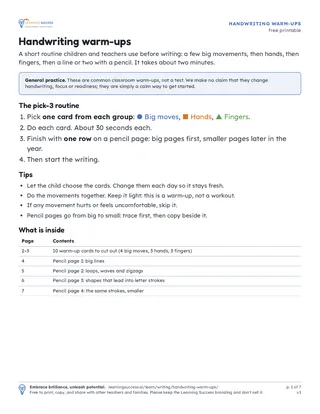
Ten warm-up cards of about 30 seconds each, and four pencil pages. They go from big arm moves down to strokes the size of letters.
When to ask for help
Each of these is a reason to ask for help on its own.
- Little change, even with steady practice and good teaching.
- Writing well below your child's other schoolwork.
- A teacher who raises a concern about writing.
- Extreme upset about writing.
- Complete avoidance of writing.
- Hopelessness about learning.
- Sadness or worry that lasts.
- Significant delays in speech, language or motor development.
- A skill that was there and has gone. Our position is that a lost skill goes to a doctor first, not a tutor.
If no skill has gone, start with the teacher. Say what you are seeing at home, and what you have tried. Beyond the teacher, the right person depends on what it turns out to be about. If the work is too hard, someone who works on that school skill. If worry or mood is the thing, someone who works with children's mental health. In our view, delays in speech, language or movement are worth raising with your child's doctor. In our view, if you are worried enough to ask, a professional evaluation is worth asking about.
Any talk of hurting themselves is a same-day call to your doctor or a crisis line.
Try the two-minute warm-up once before writing. Then write one short sentence together. This routine is ours, not a tested method. Keep any hand or finger exercise alongside handwriting practice, not in place of it. Handwriting improves most consistently with handwriting practice; motor work alone has not been shown to improve it.
”What to do tonightWhat to use next
A set of questions you answer about what you see at home. A screener is a starting point, not a diagnosis. If your child might need formal accommodations (an IEP or 504 plan), or you suspect a vision, hearing, or medical cause, pursue a professional evaluation too — that's the only route to those supports.
What the hand is doing — worked alongside handwriting practice rather than in place of it; motor work on its own has not been shown to improve handwriting.
Common questions from parents
Do warm-ups before writing help handwriting?
The warm-up on this page is ours. We hold no study of warm-ups before writing. That is a gap in what we hold, not a finding either way. Keep any hand or finger exercise alongside handwriting practice, not in place of it. Handwriting improves most consistently with handwriting practice; motor work alone has not been shown to improve it. If your child likes a warm-up, keep it short. Then go to the letters.
Why go from big to small?
"Big to small" is just the order we use. We hold no study of this order. Arms come first. Then hands, then fingers, then the pencil. In our view, that is easy to keep in mind. Keep any hand or finger exercise alongside handwriting practice, not in place of it. Handwriting improves most consistently with handwriting practice; motor work alone has not been shown to improve it.
How long should a warm-up before writing be?
Our routine takes about two minutes. We hold no study of warm-ups before writing. Shorter is fine too. If your child likes a warm-up, keep it short. Then go to the letters. Keep any hand or finger exercise alongside handwriting practice, not in place of it. Handwriting improves most consistently with handwriting practice; motor work alone has not been shown to improve it.