
Brain Breaks for the Classroom: Free Poster and Cards
A brain break is a short, planned pause between two pieces of work. It lasts one to three minutes. This free pack has a chart of 12 breaks: 8 to move and 4 to calm. It has cut-out break cards, a seated way for every break and a note for home. It is a free PDF with no email form.
TL;DR
- A brain break is a short, planned pause between two pieces of work.
- The chart has 12 breaks: 8 to move and 4 to calm.
- The pack adds cut-out cards, blank cards, a seated way for every break and a note for home.
- Use the same start words and end words every time.
- Free PDF, no email form.
A brain break is a short, planned pause of one to three minutes between two pieces of work. It has a start, an end and a way back to the task.
”brain breakWhat is in the brain breaks pack?
The pack is for short breaks your class can do by their desks.
- A chart of 12 breaks for the wall. Each break has a simple picture and one line a child can read. A triangle marks a move break. A circle marks a calm break.
- A one-page guide for adults.
- Cut-out break cards for a pick-a-break jar or bag.
- A seated way for every break.
- Six blank cards for the class to make its own breaks.
- A note for home, with a table of breaks you tried.
Pages come in color and in black and white. In black and white, the pictures are outlines to color in.
Free download: Brain breaks poster
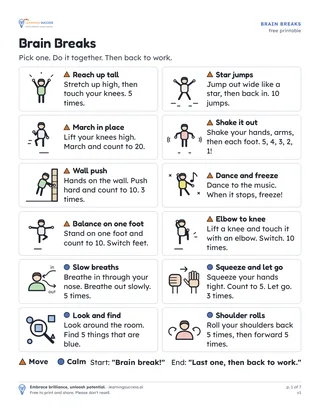
Twelve one-to-three-minute breaks, eight to move and four to calm, each with a picture and one line. There are also cut-out break cards, a seated way for every break, blank cards to make your own, a short guide and a note for home.
Free tool: Visual Timer
A countdown you can see. The colored disc shrinks as time runs out, big enough to read across a classroom or a kitchen. Free to use.
Open the Visual TimerThe 12 breaks on the chart
There are eight move breaks. They are reach up tall, star jumps, march in place and shake it out. The others are wall push, dance and freeze, balance on one foot, and elbow to knee.
There are four calm breaks. They are slow breaths, squeeze and let go, look and find, and shoulder rolls.
Pick a move break after a long time sitting. Pick a calm break after a busy time, like coming in from recess.
How to run a brain break
These steps are ours.
- Say the start words: "Brain break!"
- Name the break, or let a student pick one. Point to the chart, or pull a card from the jar.
- Do it together for one to three minutes. Join in yourself.
- Say the end words: "Last one, then back to work."
- Go straight back to the same task. Have the next step ready, like "Pencils on question 4."
When to take a brain break
- Between two tasks, or partway through a long one.
- After a long time sitting. About every 20 to 30 minutes is a common rule of thumb, not a research finding.
- When the room is restless or slow to start.
Make it work for every student
- Every break has a seated way. Use it in a small room, or for a student who uses a wheelchair. Use it on a day when standing is too much.
- Give each student an arm's length of space, by their desk or chair.
- A student may pick a calm break instead of a move break. Joining in is invited, never forced.
- A break is never taken away as a punishment. It is never something to earn. It is part of the work time.
- Keep screens and videos out of it.
Make your own brain breaks
The pack has a page of six blank cards. The class can draw a break, name it and write how to do it. Then they tick move or calm.
Check four things before a card goes in the jar. It takes one to three minutes. It is safe in a small space. It has a clear end. It has a seated way.
Brain breaks at home
The last page is a note for families. It has three tips. Use the same words, let the child pick, and go back to the same spot. It also has a "Breaks we tried" table to fill in.
When a student is still stuck
Check that the student knows the start words and the end words. Try the seated way, or a calm break.
Our page on break cards has cards one student uses to ask for a break. It is in the Read next links.
If a student still struggles after steady use of breaks, raise it with your school team. Describe what you see. Do not name a condition.
Common questions from parents
Are the brain breaks free?
Yes. The chart, cards and guide are a free PDF. There is no email form. You can print them for your class.
How long is a brain break?
One to three minutes. Each break has a clear end, so students can go back to work.
How often should students take a brain break?
We give no set number. About every 20 to 30 minutes is a common rule of thumb, not a research finding. Look for long sitting or a restless room.
Can every student join in?
Yes. Every break has a seated way. A student may pick a calm break instead. Joining in is invited, never forced.
Is a brain break the same as a break card?
No. A brain break is a short pause for the whole class, a small group or one student. A break card is a card one student uses to ask for a break.
Do brain breaks help students get back to work?
Movement breaks help children come back to a task. Classroom studies of short activity breaks found more time on task afterwards. The children in those studies were not picked for attention or learning trouble. Those studies did not test these breaks.
Where these ideas come from
Movement breaks help children come back to a task. Classroom studies of short activity breaks found more time on task afterwards.
Watson and colleagues (2017) reviewed classroom studies of active breaks in elementary schools. The breaks went with more on-task and less off-task behavior in class. The studies varied widely. We could read only the review's summary.
Maykel and colleagues (2018) studied one class. The class was compared with itself, with and without the breaks. The children took 10-minute breaks of whole-body movement. Their time on task improved for the 45 minutes the study watched. We could read only the study's summary.
The children in those studies were not picked for attention or learning trouble. Those studies do not show that breaks build attention, reading or math skill. They did not test these breaks.
A 2026 trial tested four classroom supports (Fabiano and colleagues). They were extra time, frequent breaks, a low-distraction workspace and permission to stand. None of the four improved classroom behavior or quiz scores. The trial ran in summer program classrooms, only with children diagnosed with ADHD. Its breaks came at fixed times: one minute after every five minutes of seatwork. The trial measured rule-breaking, correct classwork per minute and quiz scores, not time on task.
Nothing we cite on this page tests the calm breaks.
The twelve breaks on the chart are our own ideas. They are general practice, not a tested program. The five steps and the start and end words are ours too. So is the advice to break between tasks or when the room is restless. So is the advice on when to pick a move or a calm break. So are the seated ways and the space and screen tips. So is the rule that joining in is invited, never forced. So is the rule that a break is never taken away or earned. So are the make-your-own check, the home tips and the steps for a student who is still stuck. We have not tested them. That is not the same as being shown not to work.
Free resources you can share with families
Everything below is free. Each one is written for parents.
Screeners
- Dyslexia screener — Questions for parents about what they have noticed with reading.
- Dyscalculia screener — Questions for parents about what they see with math at home.
- Dysgraphia screener — Questions about handwriting, spelling and writing at home.
- Attention & Executive Function screener — Questions about attention, getting started and finishing.
- Learning Difficulties Analysis — One set of questions across reading, writing, spelling and math.
Our rule is to say this wherever we name a screener. It is worth passing on: "A screener is a starting point, not a diagnosis. If your child might need formal accommodations (an IEP or 504 plan), or you suspect a vision, hearing, or medical cause, pursue a professional evaluation too — that's the only route to those supports."
Reading and courses for parents
- Focus Foundations — Our free e-book and parent community for working on focus.
- The Overly Emotional Child — A free course for parents on big feelings over schoolwork.
- Growth Mindset program — A free program on effort, practice and confidence.
- The Weekly Blueprint — Practical help for parents, every week by email.
- All free resources — Downloads and free programs in one place.