
Dysgraphia Worksheets and Activities
This free home pack of dysgraphia worksheets is for a child who finds handwriting hard. Its paper and graph paper are so the lines are easy to see and use. Fill-in notes are so your child copies less. It has hand warm-up cards. Handwriting improves most consistently with handwriting practice; motor work alone has not been shown to improve it.
TL;DR
- Here is a free pack to use at home. It has dysgraphia worksheets and activities.
- The pack has lined paper and graph paper. It has fill-in notes and hand warm-up cards. Keep any hand or finger exercise alongside handwriting practice, not in place of it. Handwriting improves most consistently with handwriting practice; motor work alone has not been shown to improve it.
- Use each part for a short time of writing. Stop while it is still going well.
- Use these worksheets alongside a short handwriting lesson, not in place of it.
- Some signs mean it is time to ask for help. Our position is that a lost skill goes to a doctor first, not a tutor.
Dysgraphia is a word for a pattern of trouble with handwriting, spelling, or getting thoughts onto paper.
”DysgraphiaWhat is in the free pack?
The pack is for a child who finds handwriting hard. It is for short writing times at home.
- Hand and finger warm-up cards. For just before writing. Keep any hand or finger exercise alongside handwriting practice, not in place of it. Handwriting improves most consistently with handwriting practice; motor work alone has not been shown to improve it.
- Highlighted-baseline writing paper. The baseline is the line the letters sit on.
- Raised-line style writing paper.
- Both papers in wide and standard lines. Wide lines give more room for each letter.
- Graph paper templates. One set is for lining up math. One set is for letter size.
- Fill-in notes, for older children. Notes with blanks, so your child copies less.
Pages come in color and in black and white. The pack does not teach letter formation from A to Z. The last page names our free Dysgraphia screener. A screener is a starting point, not a diagnosis. If your child might need formal accommodations (an IEP or 504 plan), or you suspect a vision, hearing, or medical cause, pursue a professional evaluation too — that's the only route to those supports.
Free download: Handwriting paper and warm-up cards
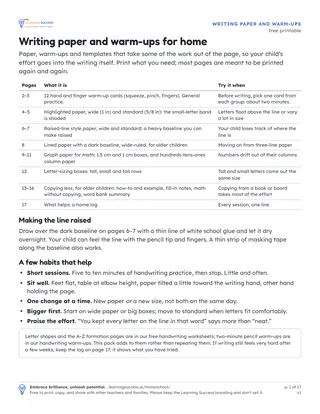
12 hand warm-up cards and several kinds of writing paper, in wide and standard sizes. There is graph paper, column paper for math and letter-sizing boxes.
The warm-up cards
The cards are so each writing time has a set start. The cards are our general practice.
Keep any hand or finger exercise alongside handwriting practice, not in place of it. Handwriting improves most consistently with handwriting practice; motor work alone has not been shown to improve it.
If your child likes a warm-up, keep it short. Then go to the letters. In our view, stop any warm-up that hurts.
Our warm-ups page has more.
What the writing paper is for
Each paper is there to make the lines easy to use.
- Highlighted baseline. So the line the letters sit on is easy to see.
- Raised-line style. So the lines are easy to find.
- Wide or standard. So you can pick the size that fits your child's writing.
In our view, the paper is a choice, not a handwriting lesson. Your child still practices the letters on it.
Our spacing and sizing page has more.
What the graph paper is for
For math. Each square holds one digit, so ones sit under ones. Tens go under tens. So the columns line up.
For letter size. Each letter goes in its own box. So your child can see how tall each letter is. In our view, spacing and size are practiced inside handwriting practice.
Graph paper is part of our practice. Use the math graph paper alongside your child's math instruction, not in place of it.
What the fill-in notes are for
The fill-in notes are for older children. Each page has notes with blanks. Your child writes only the missing words.
So your child's writing goes on the key words, not every word.
How to use the pack at home
Here is how we would use it.
- Pick one part for today. One kind of paper, or one page of notes.
- Start with a warm-up card, if your child likes them. Keep it short.
- Write for a short time. A few words or a few lines.
- Stop while it is still going well.
- Put the date on the page. Keep it with the others.
Our position is that short, frequent practice does more than long, rare sessions. In our experience, handwriting gets worse as a child tires. Stop before it falls apart.
Use these worksheets alongside a short handwriting lesson, not in place of it. Keep any hand or finger exercise alongside handwriting practice, not in place of it. Handwriting improves most consistently with handwriting practice; motor work alone has not been shown to improve it.
Our page on teaching writing at home says what to teach, and how.
If you are wondering about dysgraphia
This page cannot tell you whether your child has dysgraphia. You do not need a name to start. You can start on what you see.
Want to look more closely at writing? Our free Dysgraphia screener can help. You answer it about what you see at home. It is listed below. A screener is a starting point, not a diagnosis. If your child might need formal accommodations (an IEP or 504 plan), or you suspect a vision, hearing, or medical cause, pursue a professional evaluation too — that's the only route to those supports.
When to ask for help
Each of these is a reason to ask for help on its own.
- Little change, even with steady practice and good teaching.
- One subject well below your child's other schoolwork.
- A teacher or tutor who raises a concern.
- Extreme upset about schoolwork.
- Complete avoidance of schoolwork.
- Hopelessness about learning.
- Sadness or worry that lasts.
- Significant delays in speech, language or motor development.
- A skill that was there and has gone. Our position is that a lost skill goes to a doctor first, not a tutor.
If your child has a teacher or tutor, start there. Say what you are seeing, and what you have tried. Beyond that, the right person depends on what it turns out to be about. If the work is too hard, someone who works on that school skill. If worry or mood is the thing, someone who works with children's mental health. In our view, delays in speech, language or movement are worth raising with your child's doctor. In our view, if you are worried enough to ask, a professional evaluation is worth asking about.
Any talk of hurting themselves is a same-day call to your doctor or a crisis line.
The federal evaluation rules we hold do not mention children taught at home. In our view, ask your state or local school district.
Key Takeaways
The free pack has writing paper, graph paper, fill-in notes and hand warm-up cards.
The highlighted baseline is there so the line is easy to see.
Graph paper gives each digit its own box, so the columns line up.
Fill-in notes are there so your child copies less.
Keep any hand or finger exercise alongside handwriting practice, not in place of it. Handwriting improves most consistently with handwriting practice; motor work alone has not been shown to improve it.
Use these worksheets alongside a short handwriting lesson, not in place of it.
Our position is that a lost skill goes to a doctor first, not a tutor.
Tonight, draw one line on plain paper. Go over it with a bright marker. Your child writes one short sentence on it. Stop while it is still going well. Put the date on the page and keep it. You are not testing anything.
”What to do tonightWhat to use next
A set of questions you answer about what you see at home. A screener is a starting point, not a diagnosis. If your child might need formal accommodations (an IEP or 504 plan), or you suspect a vision, hearing, or medical cause, pursue a professional evaluation too — that's the only route to those supports.
Common questions from parents
Are the dysgraphia worksheets free?
Yes. The pack is a free PDF. There is no email form. Pages come in color and in black and white.
What are good dysgraphia activities at home?
Start with short handwriting practice. Write a few words, then stop. Handwriting improves most consistently with handwriting practice; motor work alone has not been shown to improve it. A warm-up card can come just before it. Keep it short. Then go to the letters. Keep any hand or finger exercise alongside handwriting practice, not in place of it.
Does special paper help with dysgraphia?
We cannot say it does. Two studies looked at writing lines. In one, kindergartners' letters were no more readable on lined paper than on plain paper (Daly and colleagues, 2003). In the other, close lines made children's writing smaller, but also slower and less smooth (Duiser and colleagues, 2022). We could read only their summaries. Neither one tested highlighted or raised-line style paper. In our view, the paper is a choice. It is not a handwriting lesson. Your child still practices the letters on it.
How long should a worksheet session be?
We cannot put a number on it for your child. Our position is that short, frequent practice does more than long, rare sessions. In our experience, handwriting gets worse as a child tires. Stop before it falls apart.
Where these ideas come from
The way we put these worksheets together is ours. It is our general practice.
Two studies looked at writing lines. In one, kindergartners' letters were no more readable on lined paper than on plain paper (Daly and colleagues, 2003). In the other, close lines made children's writing smaller, but also slower and less smooth (Duiser and colleagues, 2022). We could read only their summaries. Neither one tested highlighted or raised-line style paper. We hold no study of grids. That is a gap in what we hold, not a finding either way.
We hold no trial of graph paper for lining up math. That is a gap in what we hold, not a finding either way.
We hold no study of warm-ups before writing. Handwriting improves most consistently with handwriting practice; motor work alone has not been shown to improve it.
Guided notes are handouts from the teacher, with blanks to fill in during the lesson. One review pooled studies of guided notes (Konrad and colleagues, 2009). It found they helped students take more accurate notes. This was most true for school-age students. We could read only its summary. The notes were handed out by teachers, during lessons. We hold no study of fill-in notes used at home.
We hold no study of homeschooling children with dysgraphia.
No study we hold tests these worksheets as a set. That is not the same as being shown not to work.