
Homeschool Progress Report for a Struggling Learner: Free Template
This free homeschool progress report template is for a child who struggles. You mark each skill not yet, with help, or on my own. There is space to write what helped, so you can do it again. A one-page term summary gives your family a record. It has no grades. It comes in Word and PDF.
TL;DR
- Here is a free progress report template to use at home. It is for a child who struggles.
- You mark each skill not yet, with help, or on my own. So you can see what your child can do now.
- There is space to write what helped. So you can do it again.
- A one-page term summary gives your family a record of the term.
- Some signs mean it is time to ask for help. Our position is that a lost skill goes to a doctor first, not a tutor.
A progress report is a record of what your child can do. It goes skill by skill. It also says what helped.
”progress reportWhat is in the free template?
The template is for a parent who teaches at home. It is for a child who finds learning hard.
- A skills page. For each skill, you mark not yet, with help or on my own.
- Space for what helped. There is space to write what helped.
- A one-page term summary. For your family's record of the term.
- Word and PDF. The Word file can be edited. It also opens in Google Docs.
Pages come in color and in black and white. There are no letter grades and no grade levels. There is no email form.
The last page names our free Learning Difficulties Analysis. A screener is a starting point, not a diagnosis. If your child might need formal accommodations (an IEP or 504 plan), or you suspect a vision, hearing, or medical cause, pursue a professional evaluation too — that's the only route to those supports.
Free download: Homeschool progress report
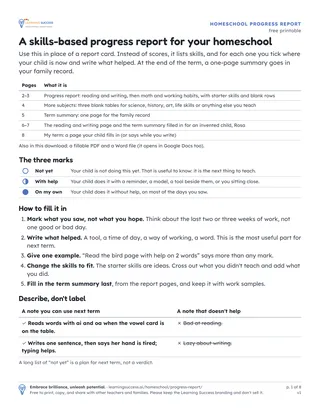
A report that lists skills in reading, writing, math and work habits. For each one you tick not yet, with help, or on my own. There is a term summary and a filled-in example.
What the three marks are for
Each mark says what your child can do with that skill today.
- Not yet. Your child cannot do it yet. You are still teaching it.
- With help. Your child can do it with you beside them. You might give a hint or do the first step.
- On my own. Your child can do it with no help from you.
The marks are so you can see where your child is, skill by skill. There is no grade, and no score.
In our view, not yet is not a fail. It just means you are still teaching that skill.
What the "what helped" space is for
Write down what made the skill easier. Keep it short.
- "Said each sound out loud first."
- "Used blocks to show the sum."
- "Did it after I showed one first."
The space is so you can do what worked again. It is also so you can see what did not help.
The term summary
The summary is one page. It is for the end of each term.
Write the skills your child can now do on their own. Write the skills still marked with help, or not yet. Write what helped most this term.
The page is so your family has a record of the term. You can put this term's page next to last term's.
How to fill it in at home
Here is how we would use it.
- Pick a few skills you are teaching now. Write down each skill.
- Keep each skill small. "Sounds out three-letter words" is a skill. "Reading" is too big.
- Mark it when you work on it. Put the date next to each mark.
- Write what helped. A few words is enough.
- Change a mark when you see the change. In our view, wait until you see it on more than one day.
- Fill in the term summary at the end of the term.
Write what you saw, not what you think it means.
Not sure which skills to list? Our guides for each area can help. Our guides to teaching reading and writing at home have more. So does our page of math activities.
Taking the record with you
You may see a tutor, a doctor or an evaluator. You can take the report with you. It shows what you have seen, skill by skill, with dates. It also shows what you have tried.
The report is your family's own record. It is not a legal document. This page does not cover state rules on homeschool records.
A portfolio of your child's work is a different record. This page does not cover it.
If you are not sure where your child is stuck
Look at your report. Is one area marked not yet far more than the rest? Then you may want to look more closely.
Not sure where it sits among reading, writing and math? Our free Learning Difficulties Analysis can help. It is one set of questions across reading, writing, spelling and math. You answer it about what you see at home. It is listed below. A screener is a starting point, not a diagnosis. If your child might need formal accommodations (an IEP or 504 plan), or you suspect a vision, hearing, or medical cause, pursue a professional evaluation too — that's the only route to those supports.
Keep your report next to you. Look at it as you answer each question.
When to ask for help
Each of these is a reason to ask for help on its own.
- Little change, even with steady practice and good teaching.
- One subject well below your child's other schoolwork.
- A teacher or tutor who raises a concern.
- Extreme upset about schoolwork.
- Complete avoidance of schoolwork.
- Hopelessness about learning.
- Sadness or worry that lasts.
- Significant delays in speech, language or motor development.
- A skill that was there and has gone. Our position is that a lost skill goes to a doctor first, not a tutor.
If your child has a teacher or tutor, start there. Say what you are seeing, and what you have tried. Beyond that, the right person depends on what it turns out to be about. If the work is too hard, someone who works on that school skill. If worry or mood is the thing, someone who works with children's mental health. In our view, delays in speech, language or movement are worth raising with your child's doctor. In our view, if you are worried enough to ask, a professional evaluation is worth asking about.
Any talk of hurting themselves is a same-day call to your doctor or a crisis line.
The federal evaluation rules we hold do not mention children taught at home. In our view, ask your state or local school district.
Key Takeaways
The free template has a skills page, space for what helped, and a term summary.
You mark each skill not yet, with help, or on my own. There are no grades.
The "what helped" space is so you can do what worked again.
The term summary is so your family has a record of the term.
Put the date next to each mark.
Our position is that a lost skill goes to a doctor first, not a tutor.
Tonight, pick one skill you worked on today. Write it down with the date. Mark it not yet, with help, or on my own. Then write one thing that helped. You are not testing anything.
”What to do tonightWhat to use next
Learning Difficulties Analysis
One set of questions across reading, writing, spelling and math. You answer it about what you see at home. A screener is a starting point, not a diagnosis. If your child might need formal accommodations (an IEP or 504 plan), or you suspect a vision, hearing, or medical cause, pursue a professional evaluation too — that's the only route to those supports.
Common questions from parents
Is the progress report template free?
Yes. It is free, with no email form. It comes as a Word file and a PDF. The Word file opens in Google Docs. Pages come in color and in black and white.
What should a homeschool progress report include?
In our view, it should list the skills you are teaching. Mark each one not yet, with help, or on my own. Add the date. Write what helped. At the end of the term, fill in a one-page summary.
Is this a homeschool report card template?
It is a progress report, not a report card. It has no letter grades and no grade levels. Instead, you mark each skill. In our view, a skill mark shows the step your child is on.
When should I fill it in?
In our view, mark a skill when you work on it. Fill in the term summary at the end of each term. We cannot put a number on it for your family.
Where these ideas come from
The way we put this template together is ours. It is our general practice.
We hold no study of skill records kept by parents at home.
We hold no study of homeschooling outcomes for children who struggle to learn.
No study we hold tests this template. That is not the same as being shown not to work.