
An ADHD Homeschool Schedule That Works: A Free Day Planner
This page gives you a free ADHD homeschool day planner. It has a day plan in short work blocks, with movement breaks marked. It has a routine chart for morning, school time and after. It has a home checklist for noticing patterns, not for testing. It is a free PDF with no email form.
TL;DR
- A free day planner for homeschooling a child with ADHD or attention trouble.
- The pack has a day plan, a routine chart and a home checklist.
- The day plan sets out short work blocks. A movement break comes after each one.
- The block length is a starting point we chose. Watch your child, and change it if it is too long.
- The checklist is for noticing patterns, not for deciding anything.
- Some signs mean it is time to ask for help. Our position is that a lost skill goes to a doctor first, not a tutor.
A work block is a short stretch of school work with a set end. A movement break comes after it.
”work blockWhat is in the free day planner?
The pack is for planning a school day at home in short pieces.
- A one-page day planner. It sets out the day in short work blocks. The movement breaks are marked. There is a blank version and a filled example day.
- A routine chart. It has three parts: morning, school time, and after. There is a picture version and a word version. Some lines are left blank for your own steps.
- A one-page home checklist. It has four parts: starting, planning, keeping track, and finishing. Each has tick boxes. It is a noticing tool, not an assessment.
Pages come in color and in black and white. The last page names our free Attention & Executive Function screener. A screener is a starting point, not a diagnosis. If your child might need formal accommodations (an IEP or 504 plan), or you suspect a vision, hearing, or medical cause, pursue a professional evaluation too — that's the only route to those supports.
Free download: Homeschool day planner
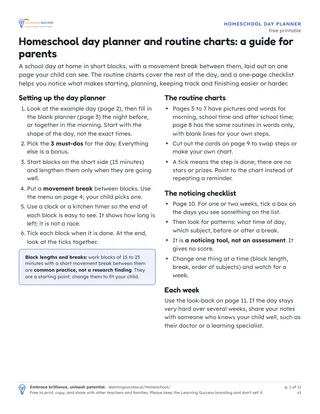
A one-page planner with short work blocks and a movement break between each one. There is a filled-in example, a fillable blank planner, a break menu, routine charts and 20 picture cards.
How to set up the day in short blocks
Here is how we would use the day planner.
- Fill in the blank planner the night before. So the next day is ready before it starts.
- Write one task in each work block. So your child has one job at a time.
- Keep each block short. So your child can see the end of it.
- Put a movement break after each block. So a break comes before your child is worn out.
- Put the hardest subject at your child's best time. Notice when that is.
- Say when a block will end before it starts. So the end is not a surprise.
- Look at the plan together at the start of the day. So your child knows what comes next.
The planner uses work blocks of 15 to 25 minutes. That is a starting point we chose. It is common practice, not a research finding.
A break can be short. Your child gets up and moves, then comes back. The planner marks a movement break after each block. That is common practice, not a research finding.
Teach the subject itself in each block. The breaks go alongside the teaching, not in place of it.
How to change the plan
The planner is a starting point. You know your child best.
- If a block is too long, make it shorter. Try a shorter one the next day.
- If a block goes well, keep it. In our view, start short and add time slowly.
- Stop while it is still going well. A block can end early.
- Change one thing at a time. Then you can tell what made the difference.
Write down what you change, and how the day went. The example day shows one way to fill it in. Your own day can look different.
The routine chart
The routine chart sets out the same steps in the same order each day. It has a morning part, a school-time part, and an after part.
- Same steps each day. So the day looks the same each morning.
- Pictures or words. Use the picture version if your child does not read yet.
- Blank lines. So you can add the steps that fit your home.
- Mark each step when it is done. So your child can see what is next.
In our view, a routine that stays the same means fewer choices each morning. Our page on organization skills has more on routines a child can see.
The home checklist: for noticing, not deciding
The checklist has four parts: starting, planning, keeping track, and finishing. Each part has tick boxes.
The checklist is for you to notice patterns. It is not a test. It cannot tell you whether your child has ADHD.
- Tick what you see on an ordinary day. Do not wait for a hard day.
- Note the time and the task. So you can see when things go well.
- Look back at the ticks after a while. See which part comes up again and again.
- Bring the checklist to a professional if you ask for help. It shows what you saw at home.
If one part stands out, you can plan for it. If starting is hard, write the first step on the planner.
If you are wondering about ADHD
This page cannot tell you whether your child has ADHD. You do not need a name to start. You can start on what you see.
Want to look more closely at attention? Our free Attention & Executive Function screener can help. It asks about focus, and how your child starts and finishes work. You answer it about what you see at home. It is listed below. It cannot tell you if your child has ADHD. A screener is a starting point, not a diagnosis. If your child might need formal accommodations (an IEP or 504 plan), or you suspect a vision, hearing, or medical cause, pursue a professional evaluation too — that's the only route to those supports.
When to ask for help
Each of these is a reason to ask for help on its own.
- Little change, even with steady practice and good teaching.
- One subject well below your child's other schoolwork.
- A teacher or tutor who raises a concern.
- Extreme upset about schoolwork.
- Complete avoidance of schoolwork.
- Hopelessness about learning.
- Sadness or worry that lasts.
- Significant delays in speech, language or motor development.
- A skill that was there and has gone. Our position is that a lost skill goes to a doctor first, not a tutor.
If your child has a teacher or tutor, start there. Say what you are seeing, and what you have tried. Beyond that, the right person depends on what it turns out to be about. If the work is too hard, someone who works on that school skill. If worry or mood is the thing, someone who works with children's mental health. In our view, delays in speech, language or movement are worth raising with your child's doctor. In our view, if you are worried enough to ask, a professional evaluation is worth asking about.
We cannot tell you whether your child has ADHD. In our view, take a question about ADHD to your child's doctor. Our page on attention and ADHD says who can diagnose it.
Any talk of hurting themselves is a same-day call to your doctor or a crisis line.
The federal evaluation rules we hold do not mention children taught at home. In our view, ask your state or local school district.
Key Takeaways
The free pack has a day planner, a routine chart and a home checklist.
The planner sets out short work blocks, with a movement break after each one.
The 15 to 25 minute block is a starting point we chose. Change it to fit your child.
The routine chart keeps the same steps in the same order each day.
The checklist is for noticing patterns. It is not a test.
Our position is that a lost skill goes to a doctor first, not a tutor.
Tonight, plan tomorrow in three short blocks. Put one task in each. Put a movement break after each block. Tomorrow, note which block went well and which ran too long. This is a record, not a test.
”What to do tonightWhat to use next
Attention & Executive Function screener
Questions about attention, getting started and finishing. You answer it about what you see at home. A screener is a starting point, not a diagnosis. If your child might need formal accommodations (an IEP or 504 plan), or you suspect a vision, hearing, or medical cause, pursue a professional evaluation too — that's the only route to those supports.
Common questions from parents
Is the ADHD homeschool day planner free?
Yes. The day planner, routine chart and home checklist are a free PDF. There is no email form. Pages come in color and in black and white.
How long should each work block be?
Start with 15 to 25 minutes, as the planner does. That is a starting point we chose. It is common practice, not a research finding. If a block is too long, make it shorter. Stop while it is still going well.
What goes on an ADHD routine chart?
The chart in the pack has three parts: morning, school time, and after. Put the same steps in the same order each day. Use pictures, words, or both. Blank lines let you add your own steps.
Is the checklist a test for ADHD?
No. It is a noticing tool, not an assessment. It is for noticing what comes up again and again. Bring it with you if you ask for help.
Where these ideas come from
The way we put this planner together is ours. It is our general practice.
The 15 to 25 minute block is a starting point we chose. It is common practice, not a research finding.
We hold no study of homeschooling children with ADHD. We hold no research on daily routines as a whole.
The nearest studies we hold on breaks are from classrooms, not homes. Watson and colleagues (2017) reviewed classroom studies of active breaks in elementary schools. The breaks went with more on-task and less off-task behavior in class. The children in those studies were not picked for attention or learning trouble. The studies varied widely. We could read only the review's summary.
One 2026 trial tested four supports for children diagnosed with ADHD (Fabiano and colleagues, 2026). They were extra time, frequent breaks, standing, and a quiet desk. In summer classes, none of the four helped behavior or quizzes. By its registry, the trial left out children taught at home. It did not test a day at home.
No study we hold tests this planner, the routine chart or the checklist. That is not the same as being shown not to work.