
Dyscalculia Strategies, Games and Worksheets for Home
This page gives you a free pack of dyscalculia games and worksheets for home. It has dot cards, ten-frame cards, a number-line game and a make-ten card game. The worksheets show amounts as pictures before numbers, with few problems per page. A parent card for each game says how to play. It is a free PDF with no email form.
TL;DR
- This page gives you a free pack of math games and worksheets for home.
- The games are dot cards, ten-frame cards, a number-line game and a make-ten card game.
- The worksheets show amounts as pictures before numbers. Each page has only a few problems.
- The pack goes from objects, to pictures, to numbers. Your child says each number aloud.
- Some signs mean it is time to ask for help. Our position is that a lost skill goes to a doctor first, not a tutor.
A ten frame is a box of ten squares, in two rows of five. Your child fills squares to show a number.
”ten frameWhat is in the free pack?
The pack is for short, hands-on math practice at home.
- Dot cards. Cards with dots on them, to say how many.
- Ten-frame cards. Cards that show a number in a ten frame.
- A number-line game. A game played on a line of numbers.
- A make-ten card game. A card game about how many more make ten.
- Worksheets. They show amounts as pictures before numbers. Each page has only a few problems.
- An answer key for the worksheets.
- Short parent cards, one for each game. Each says how to play, five minutes at a time.
Use the pack alongside your child's math instruction, not in place of it.
Pages come in color and in black and white. A "more ideas" line names our Build It, Count It book. The last page names our free Dyscalculia screener. A screener is a starting point, not a diagnosis. If your child might need formal accommodations (an IEP or 504 plan), or you suspect a vision, hearing, or medical cause, pursue a professional evaluation too — that's the only route to those supports.
Free download: Hands-on math pack
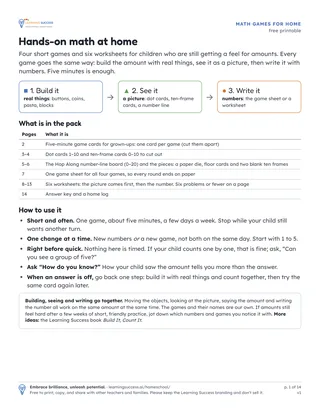
Four short games, each with a five-minute card for the grown-up, and the cards and pieces to cut out. There is a game sheet with a paper step for each game, and six worksheets.
Objects, then pictures, then numbers
The pack goes from objects, to pictures, to numbers.
- Objects first. Your child moves real things, like buttons. So each number stays tied to an amount.
- Then pictures. The worksheets show the amount as a picture. So your child sees the amount before the number.
- Then numbers. Your child writes the number beside the picture. So the number sits beside the amount.
When a page gets hard, go back a step. Bring the buttons out again. Put them away only once your child gets it right without them.
What multisensory math means here
Multisensory math means sight, sound and movement together, on the same problem.
- Your child moves the objects. Seven buttons, split into five and two.
- Your child says what happens. "Five and two make seven."
- Your child writes the numbers. 5 + 2 = 7.
All three go on the same problem. So the objects, the words and the numbers match.
How to play the games
Here is how we would play each one. Each game is practice of something you have taught.
Dot cards. Show a card for a moment. Your child says how many. Then they count the dots to check. Then they say the number again, and write it. So your child says each number, and the number sits beside the amount.
Ten-frame cards. Show a card. Ask how many are filled. Then ask how many are empty. So your child sees how close the number is to ten.
Number-line game. Put a finger on a number. Hop forward to add. Hop back to take away. Your child says each number on the way. So your child sees where each number sits.
Make-ten card game. Turn over a card. Ask how many more make ten. Check with buttons if you need to. So your child sees the pairs that make ten.
The parent cards suggest five minutes for each game. That is a starting point we chose, not a research finding. Stop while it is still going well. So practice is short, and ends on a good note.
Our page on number board games has more on games with numbers.
How to use the worksheets
Here is how we would use them.
- Pick one idea you have taught. Use only the pages for that idea.
- Start with the picture. Your child says the amount out loud.
- Then write the number. So the number sits beside the amount.
- Do one page at a time. Each page has few problems, so your child sees one small job.
- Check the answer key together. So you fix any mistake together, while the page is fresh.
We do not time the worksheets. Getting it right comes first.
Our page on the skills under math has more ideas without paper. Our free printable math activities page has another pack.
Dyscalculia strategies the pack uses
Here are the ideas the pack is built on. Each one says what it is for.
- Objects and pictures beside the numbers. So each number stays tied to an amount.
- A number line. So your child sees where each number sits.
- Saying each number aloud. So you hear each number your child says.
- Short practice on what you have taught. So practice stays on what your child has learned.
- Getting it right before going fast. So speed never becomes the point.
The last section of this page says where each of these comes from.
If you are wondering about dyscalculia
Dyscalculia describes lasting difficulty with number and calculation, out of step with the rest of a child's learning. This page cannot tell you whether your child has dyscalculia. You do not need a name to start. You can start on what you see. Play the games with your child. Watch how they get each answer. Note what comes easily, and what is hard. Keep the notes in one place.
Want to look more closely at math? Our free Dyscalculia screener can help. You answer it about what you see at home. It is listed below. A screener is a starting point, not a diagnosis. If your child might need formal accommodations (an IEP or 504 plan), or you suspect a vision, hearing, or medical cause, pursue a professional evaluation too — that's the only route to those supports.
When to ask for help
Each of these is a reason to ask for help on its own.
- Little change, even with steady practice and good teaching.
- One subject well below your child's other schoolwork.
- A teacher or tutor who raises a concern.
- Extreme upset about schoolwork.
- Complete avoidance of schoolwork.
- Hopelessness about learning.
- Sadness or worry that lasts.
- Significant delays in speech, language or motor development.
- A skill that was there and has gone. Our position is that a lost skill goes to a doctor first, not a tutor.
If your child has a teacher or tutor, start there. Say what you are seeing, and what you have tried. Beyond that, the right person depends on what it turns out to be about. If the work is too hard, someone who works on that school skill. If worry or mood is the thing, someone who works with children's mental health. In our view, delays in speech, language or movement are worth raising with your child's doctor. In our view, if you are worried enough to ask, a professional evaluation is worth asking about.
Any talk of hurting themselves is a same-day call to your doctor or a crisis line.
The federal evaluation rules we hold do not mention children taught at home. In our view, ask your state or local school district.
Key Takeaways
The free pack has dot cards, ten-frame cards, a number-line game and a make-ten card game.
The worksheets show amounts as pictures first. Each page has few problems.
The pack goes from objects, to pictures, to numbers.
Here, multisensory math means your child moves, says and writes, all on one problem.
Five minutes a game is a starting point we chose, not a research finding.
Use the pack alongside your child's math instruction, not in place of it.
Our position is that a lost skill goes to a doctor first, not a tutor.
Tonight, count out seven buttons with your child. Split them into a pile of five and a pile of two. Your child says what they see: "Five and two make seven." Then they write 5 + 2 = 7. Try two more splits. Note which ones came easily.
”What to do tonightWhat to use next
A set of questions you answer about what you see at home. A screener is a starting point, not a diagnosis. If your child might need formal accommodations (an IEP or 504 plan), or you suspect a vision, hearing, or medical cause, pursue a professional evaluation too — that's the only route to those supports.
Books from Learning Success
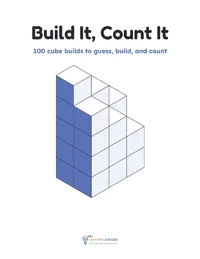
100 cube builds to guess, build, and count
One cube build per page. Your child guesses how many cubes, then builds it. Any same-size cubes work. Then your child counts and says how many more make the next ten. Some cubes are hidden. Answers are at the back. Use it beside your child's math, not instead of it. Paperback and Kindle.
See the bookCommon questions from parents
Are the dyscalculia worksheets free?
Yes. The worksheets and games are a free PDF. There is no email form. Pages come in color and in black and white.
What are good math games for a child with dyscalculia?
The pack has four: dot cards, ten-frame cards, a number-line game and a make-ten card game. Each one is short practice of what you have taught. Your child says each number aloud. Our page on number board games has more.
What is multisensory math?
Multisensory math uses sight, sound and movement together, on the same problem. Your child moves the objects. They say what happens. Then they write the numbers. All three go on one problem.
Is this pack a dyscalculia program?
No. This pack is home practice. It is not a dyscalculia program. Use the pack alongside your child's math instruction, not in place of it.
How do I teach times tables to a child with dyslexia?
Teach a few facts at a time. Build each one with objects first. Three groups of four buttons show 3 × 4. Keep the buttons near, so your child can work out a fact they forget. Getting it right comes first, not speed. A German medical guideline summary says people with dyscalculia are more likely to also have dyslexia (Haberstroh and Schulte-Körne, 2019). A 2021 federal guide on extra math help advises short timed practice, on facts already taught. It rates the evidence for that advice as strong. Strong means its studies kept finding gains, across different groups of children. That grade is for the advice as a whole, not for each step in it. The guide's order starts with zeros and ones, then tens and fives. The order is the panel's advice. The guide's studies were of help given in school, not at home. Our page on the skills under math has more.
Where these ideas come from
The way we put this pack together is ours. It is our general practice.
The parent cards say five minutes a game. That is a starting point we chose. It is not a research finding.
A US federal guide on extra math help came out in 2021 (Fuchs and colleagues). It is about help in small groups or one to one, at school. It is not a guide to dyscalculia. Its studies were of help given in school, not at home.
The 2021 guide rates the evidence for hands-on and drawn models, linked to the numbers, as strong. Which model suits which topic is the panel's advice. The guide also rates the evidence for number lines as strong. Strong means its studies kept finding gains, across different groups of children. Its studies were of help given in school, not at home. Each grade is for the advice as a whole, not for each step in it. Using dot cards and ten frames is our choice of model. The 2021 guide has no study of a parent using number lines or models at home.
The guide advises short timed practice, on facts already taught. It rates the evidence for that advice as strong. Strong means its studies kept finding gains, across different groups of children. The guide's panel adds one view on timed sheets. In its words: "In the opinion of the panel, giving timed worksheets alone does not support fluency." That view is about help at school. Not timing the worksheets is our choice, not the guide's advice.
A German medical guideline summary looked at help for dyscalculia (Haberstroh and Schulte-Körne, 2019). Practice made of math tasks did better than training other skills, like working memory. The guideline says high-quality trials are still lacking. It recommends that trained specialists give this help, one to one. For that help, it recommends sessions of at least 45 minutes. The games on this page are home practice, not that kind of specialist help.
The number board game trials we hold ran from preschool to second grade. We hold no number board game trial in children with dyscalculia. Nor do we hold one beyond second grade.
We hold no study of homeschooling children with dyscalculia. We hold no study of times tables for children with dyslexia.
No study we hold tests this pack, its games or its worksheets. That is not the same as being shown not to work.