
Free Printable Math Activities for Struggling Learners
This pack is ours. We hold no study that tests it. The free number sense pack has ten-frame cards, dot cards and number lines. A 2021 federal guide (Fuchs and colleagues) rates number lines as strong. Its studies were of help given in school, not at home. Use the pack alongside your child's math instruction, not in place of it.
TL;DR
- This pack is ours. We hold no study that tests it.
- The pack has cards, number lines and games for number sense.
- The pack is free. There is no form to fill in.
- A 2021 federal guide (Fuchs and colleagues) rates number lines as strong. That is for math in general. Its studies were of help given in school, not at home.
- Use the pack alongside your child's math instruction, not in place of it.
What is in the free math pack?
This pack is ours. We hold no study that tests it. That is a gap in what we hold, not a finding either way. We label this page "general practice."
The pack has nine pages. It was made for kindergarten to grade 3. Here is what is in it, in page order.
- A note for you. It says what number sense is. It says what each page is, with a quick way to use it. It gives three habits. It suggests five to ten minutes for each piece.
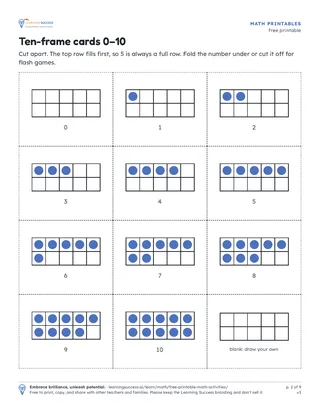
- Ten-frame cards. They show 0 to 10, plus one blank card. You cut them out.
- Dot cards. They show 0 to 10, plus one blank card. You cut them out. The 10 card is two rows of five.
- A number line from 0 to 20. There are three copies to cut out. There are three short games, too.
- Number lines from 0 to 100. They come as two strips, 0 to 50 and 50 to 100. There are two sets.
- A part-whole mat. It has a space for the whole and two parts. Lines below it read " and __ make ."
- A Make 10 game board. It is for two players. It uses the ten-frame cards. The question is how many more make 10.
- A counting-on page. It has ten problems. A number line from 0 to 20 sits beside them.
- An answer key. It also lists the pairs that make 10.
Pages come in color and in black and white. The pack is free. There is no form to fill in.
Free download: Math printables, K to 3
Ten-frame and dot cards from 0 to 10, number lines to 20 and to 100, a part-whole mat, a make-10 game and a counting-on page.
What the federal math guide says
A US federal guide on extra math help came out in 2021 (Fuchs and colleagues). It is about help in small groups or one to one, at school. It is not a guide to dyscalculia. Its studies were of help given in school, not at home. Nothing in the guide tests Learning Success.
The 2021 guide suggests number lines for children who struggle with math. It rates the evidence for number lines as strong, for math in general.
Some pages in the pack use number lines. The guide's strong rating is for help given in school, not for our pack.
The guide rates the evidence for hands-on and drawn models, linked to the numbers, as strong. The guide shows the model and the numbers together. Which model suits which topic is the panel's advice. Using ten frames, dot cards and a part-whole mat is our choice of model.
How we would use each piece
The cards. In our view, start with the ten-frame cards. Show a card and ask how many. Let your child count if they need to. Then do the same with the dot cards.
Our page on the skills under math has more.
The number lines. In our view, start with the 0 to 20 line. Put a finger on a number. Hop forward to add. Hop back to take away. Later, move to the 0 to 100 strips.
Our page on number line activities has more.
Counting on and Make 10. In our view, keep the number line beside the counting-on page. Start at the bigger number and count up. For Make 10, use the ten-frame cards. Look at a card. How many more make 10? The answer key lists the pairs.
Our page on making ten and counting on has more.
The part-whole mat. In our view, put 7 buttons in the whole. Move some into each part. Then fill in a line: 3 and 4 make 7.
One page at a time. In our view, use one page in a sitting. Stop while it is still going well.
This habit is ours. We hold no study that names it.
Is this a dyscalculia pack?
This pack is number sense practice. It is not a dyscalculia program. The last page of the pack points to our free dyscalculia screener. A screener is a starting point, not a diagnosis.
When to ask for help
Each of these is a reason to ask for help on its own.
- Little change, even with steady practice and good teaching.
- Math well below your child's other schoolwork.
- A teacher who raises a concern about math.
- Extreme upset about math.
- Complete avoidance of math.
- Worry about math that spreads into the rest of learning.
- Sadness or worry that lasts.
- A skill that was there and has gone. Our position is that a lost skill goes to a doctor first, not a tutor.
If no skill has gone, start with the teacher. Say what you are seeing at home, and what you have tried. Beyond the teacher, the right person depends on what it turns out to be about. If the work is too hard, someone who works on that school skill. If worry or mood is the thing, someone who works with children's mental health. In our view, if you are worried enough to ask, a professional evaluation is worth asking about.
Any talk of hurting themselves is a same-day call to your doctor or a crisis line.
What to use next
A set of questions you answer about what you see at home. A screener is a starting point, not a diagnosis. If your child might need formal accommodations (an IEP or 504 plan), or you suspect a vision, hearing, or medical cause, pursue a professional evaluation too — that's the only route to those supports.
What sits underneath arithmetic, one skill at a time, worked alongside math instruction, not in place of it.
A parent course inside All Access on the layer under your child's math: where numbers sit on a line, five and ten as landmarks, breaking numbers apart, and whether an answer makes sense. Five-minute moments with things already in the house. Use it alongside math instruction, not in place of it. The activities are adapted from ones tested mostly with researchers and teachers. How well they work with a parent at the table has barely been studied, and not at all past about age seven. It comes after our parent course, Foundations.
Common questions from parents
Are these math printables really free?
This pack is ours. We hold no study that tests it. The pack is free. There is no form to fill in. Pages come in color and in black and white. The pack has nine pages.
Is this a dyscalculia worksheet pack?
This pack is ours. We hold no study that tests it. This pack is number sense practice. It is not a dyscalculia program.
Is there research behind this pack?
This pack is ours. We hold no study that tests it. Some pages use number lines. A 2021 federal guide on extra math help suggests number lines. It rates the evidence for them as strong, for math in general. Its studies were of help given in school, not at home. Nothing in the guide tests Learning Success. Use the pack alongside your child's math instruction, not in place of it.