
Dyslexia Worksheets and Games for Home
This page gives you a free pack of dyslexia worksheets and games for home. The worksheets have large, clear type and one task per page. There are phonics games for one child, and a heart-word page. Each part is short practice of what you have taught. It is a free PDF with no email form.
TL;DR
- This page gives you a free pack of worksheets and phonics games for home.
- The worksheets have large, clear type, lots of space, and one task per page.
- The games are for one child: sound-match cards, a roll-and-read board and a short-vowel bingo card.
- Use each part as short practice of a sound you have taught. Your child says each sound aloud.
- Some signs mean it is time to ask for help. Our position is that a lost skill goes to a doctor first, not a tutor.
A heart word has a part that does not follow the patterns your child knows yet. Said is one. The tricky part can be marked with a heart.
”heart wordWhat is in the free pack?
The pack is for short practice at home, one sound at a time.
- Worksheets. Large, clear type, lots of space, and one task on each page. There is a cream background option.
- Sound-match cards. A card game for you and one child.
- A roll-and-read board. Roll, then read the word you land on.
- A short-vowel bingo card. A short vowel is the vowel sound in cat, bed, sit, mop or sun.
- A heart-word page. For practice with words that have a tricky part.
- An answer key wherever a page has answers.
Pages come in color and in black and white. The last page names our free Dyslexia screener. A screener is a starting point, not a diagnosis. If your child might need formal accommodations (an IEP or 504 plan), or you suspect a vision, hearing, or medical cause, pursue a professional evaluation too — that's the only route to those supports.
Free download: Reading worksheets and sound games
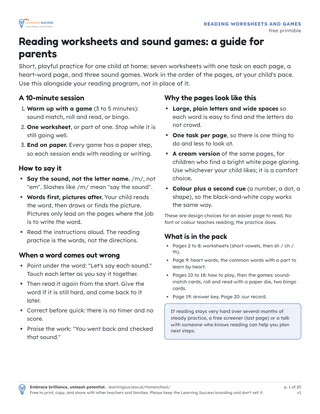
Seven worksheets in large, plain print with one task on each page, and a heart-word page. There are three games to play together: sound-match cards, roll and read, and short-vowel bingo. A one-page parent guide is included.
What each design choice is for
Each choice in the pack is there to make the page easier to read.
- Large, clear type. So each letter is easy to see.
- Lots of space. So the words do not crowd each other.
- One task per page. So your child sees one job at a time.
- A cream page option. So you can print on the background your child likes.
The choices do not teach reading.
How to use the worksheets
Here is how we would use them.
- Pick one sound or pattern you have taught. Use only the pages for that one.
- Keep it short. Stop while it is still going well.
- Say the sound first. Point to the letters as you say it.
- Your child says each sound aloud. So your child says every sound, not a guess. Then they blend the sounds into the word.
- Your child reads the word back.
- Check the answer key together if the page has one.
The worksheets and games are practice of what you have taught. Use them alongside reading instruction, not in place of it.
The phonics games
Here is how we would play each one. Each one is practice of a sound your child has been taught.
Sound-match cards. Lay out a few cards. Your child says the sound on a card, then finds its match. Mix a few old sounds in with the new one.
Roll-and-read board. Your child rolls and moves. They read aloud the word they land on. They say each sound, then the whole word.
Short-vowel bingo. Call out a word or a sound on the card. Your child finds it, says it, and covers it.
Build a word. This one is not in the pack, and needs no printing. Build cat with letter tiles, and your child reads it. Swap the c for h to make hat. Our phonics activities page has more.
To us, a game is a way to keep practice light. In our view, a child who feels tested can stop answering. If a game turns into guessing, slow down. Point back to the letters, and sound it out together.
Heart words: sight words with a tricky part
Sight words are words a child reads straight away, without sounding them out. Some do not follow the patterns your child knows yet. Those are heart words.
The heart-word page is for practice with the tricky part. Here is how we teach one.
- Read the word to your child. "Said."
- Sound out the parts that follow the patterns. In said, the s and the d sound as expected.
- Draw a heart over the tricky part. In said, the ai says /e/. That is the part to learn by heart.
- Write the word. Say each sound as you write it.
- Read it again later. Check it on more than one day.
Keep only a few new heart words going at once. Some children need more practice with a word before they know it. Give those words more short rounds.
In our view, heart words are taught alongside phonics, not in place of it.
If you are wondering about dyslexia
Dyslexia is a name for a pattern of trouble reading words, spelling, or both. This page cannot tell you whether your child has dyslexia. You do not need a name to start. You can start on what you see.
Want to look more closely at reading? Our free Dyslexia screener can help. You answer it about what you see at home. It is listed below. A screener is a starting point, not a diagnosis. If your child might need formal accommodations (an IEP or 504 plan), or you suspect a vision, hearing, or medical cause, pursue a professional evaluation too — that's the only route to those supports.
When to ask for help
Each of these is a reason to ask for help on its own.
- Little change, even with steady practice and good teaching.
- One subject well below your child's other schoolwork.
- A teacher or tutor who raises a concern.
- Extreme upset about schoolwork.
- Complete avoidance of schoolwork.
- Hopelessness about learning.
- Sadness or worry that lasts.
- Significant delays in speech, language or motor development.
- A skill that was there and has gone. Our position is that a lost skill goes to a doctor first, not a tutor.
If your child has a teacher or tutor, start there. Say what you are seeing, and what you have tried. Beyond that, the right person depends on what it turns out to be about. If the work is too hard, someone who works on that school skill. If worry or mood is the thing, someone who works with children's mental health. In our view, delays in speech, language or movement are worth raising with your child's doctor. In our view, if you are worried enough to ask, a professional evaluation is worth asking about.
Any talk of hurting themselves is a same-day call to your doctor or a crisis line.
The federal evaluation rules we hold do not mention children taught at home. In our view, ask your state or local school district.
Key Takeaways
The free pack has worksheets, three phonics games and a heart-word page.
Large type, space and one task per page are there to make the page easier to read.
Use each part as short practice of a sound you have taught.
Your child says each sound aloud, then reads the whole word.
A heart word has a tricky part. A heart drawn over it is so your child sees where it is.
Use the pack alongside reading instruction, not in place of it.
Our position is that a lost skill goes to a doctor first, not a tutor.
Tonight, pick one sound your child has been taught. Write three short words with it on cards. Your child says each sound, then the word. Stop while it is still going well. Note which words were easy and which took work.
”What to do tonightWhat to use next
A set of questions you answer about what you see at home. A screener is a starting point, not a diagnosis. If your child might need formal accommodations (an IEP or 504 plan), or you suspect a vision, hearing, or medical cause, pursue a professional evaluation too — that's the only route to those supports.
A course of word ladders, the same swap as Build a word above. Each step changes one letter to make a new word: cat, bat, bad. No study of Word Ladders exists, so nothing is claimed for it on reading or spelling. It runs alongside reading and spelling instruction, not in place of it. It comes only as part of All Access.
Common questions from parents
Are the dyslexia worksheets free?
Yes. The worksheets, games and heart-word page are a free PDF. There is no email form. Pages come in color and in black and white.
What are good dyslexia games to play at home?
The pack has three: sound-match cards, a roll-and-read board and a short-vowel bingo card. Each one is practice of a sound you have taught. Your child says each sound aloud. Keep each game short.
What are heart words?
A heart word has a part that does not follow the patterns your child knows yet. In said, the ai says /e/. You can draw a heart over that part. Your child sounds out the rest, and learns the heart part by heart.
Are these worksheets enough to teach reading?
No. They are practice pages and games, not the teaching itself. Use them alongside reading instruction, not in place of it.
Where these ideas come from
The way we put these worksheets and games together is ours. It is our general practice.
The pack uses large, clear sans-serif type. Two studies of fonts made for dyslexia found children read no faster or more accurately in them. The studies were by Kuster and colleagues (2018) and Wery and Diliberto (2017). A review found the evidence does not support colored overlays or tinted lenses for reading. Griffiths and colleagues wrote that review in 2016. In our view, the cream page is a choice, not a reading aid.
A federal reading guide came out in 2016 (Foorman and colleagues). It is not a guide to dyslexia. Almost all its studies were done in schools, not at home. It says to teach children which letters make which sounds. It says to teach them to sound out words. It rates the evidence for that advice as strong. Building words by changing one letter is one of its steps. Teaching words that do not follow the patterns is another. That grade is for the advice as a whole, not for each step in it.
One small, old study compared beginning readers with older readers who struggled (Ehri and Saltmarsh, 1995). The older readers took more tries to learn the same words.
We hold no study of homeschooling children with dyslexia. We also hold no study of marking the tricky part of a word with a heart.
No study we hold tests these worksheets and games as a set. That is not the same as being shown not to work.