
No one tells you that a timed math worksheet is measuring two different things at once, and quietly pretends they are the same. One is whether your child understands the math. The other is how fast she pulls a number fact up out of memory. The clock does not tell them apart.
So when she takes sixteen minutes for three problems, pencil moving the whole time, you are watching a child doing real math. She is doing it the long way, rebuilding each fact from the start instead of recalling it. That is slow. It is not the same as not understanding. What you are watching is effort, not the lack of it.
Your child is not broken, and slow is not the same as bad at math. One specific skill, pulling number facts up fast, has not become automatic yet. That skill is built with practice, and the sixteen minutes is the part that shrinks.
TL;DR
- Taking sixteen minutes for three problems is rarely a sign that a child is bad at math or not trying. It usually means her number facts are accurate but not yet automatic, so she rebuilds each one from scratch instead of recalling it. That is a fluency gap, not a thinking gap.
- When a fact is not automatic, working it out from scratch takes time and attention. So a multi-step problem turns slow and tiring, even when she understands it completely. A timed worksheet measures retrieval speed and reads it as math ability. Those are two different things.
- Fact fluency and number sense are built through short, concrete, daily practice, worked alongside the math she is already learning rather than in place of it. Protecting her from the timed comparison while you build it matters as much as the practice does.
Slow is not the same as bad at math. The clock in that room measures how automatic her number facts are, and reads the result as ability.
“– Laura Lurns
What the sixteen minutes is actually measuring
Picture the steps hidden inside one problem. To add eight and seven, a fluent child recalls fifteen in under a second and moves on. A child without that fact automatic counts up from eight. She keeps track on her fingers, lands on fifteen, then has to remember what the problem was even asking. Every step is correct. Every step costs a few seconds and a little attention. Stack three problems on a clock and the seconds pile up, while the understanding underneath stays perfectly intact. The skill that is thin here is retrieval: pulling a known fact up fast, without rebuilding it every time. It sits on top of solid number sense, the feel for what quantities are and how they fit together. Build the facts and the number sense under them, and the retrieval gets faster. The sixteen minutes is the symptom, not the ceiling.
The test everyone trusts is testing the wrong thing
Here is the part the system leaves out. The timed test was built to be quick to grade, not to be fair to a slow retriever. It rewards speed of recall. So a child who reasons well but recalls slowly ends up with the same low mark as a child who does not understand at all. Two different children, one number, and no way for the clock to tell you which is which. The story your daughter writes from that number is the heavier problem. She counts the finished pencils, sees herself last again, and decides she is the one who is bad at this. That decision is a prediction about her future, not a fact about her brain. Math is a skill set, not a talent you are born with or without. Even a real math difference responds to teaching. Dyscalculia shows up in roughly three to seven percent of people, depending on where the cut-off is drawn (Haberstroh and Schulte-Korne, 2019). It is a difference in how the brain handles quantity, and it responds to targeted teaching (Butterworth, Varma and Laurillard, 2011). And slowness under a clock is often not a math difference at all. It is a fact-fluency gap sitting next to a child who dreads being timed, and the two are separate things that often travel together (Devine and colleagues, 2018).

When a parent tells me their child is slow at math, the first thing I look at is not the math. It is whether the basic facts come up on their own or get rebuilt from scratch every single time. Often the understanding is already there and only the retrieval is thin, and that is good news, because retrieval is a skill that builds with the right practice. What changes first is not the test score. It is her face, once the clock stops being the thing that decides who she is.
Key Takeaways
A slow math time usually measures one narrow skill, retrieval speed, and not whether a child understands the math. Separate the two before you let anyone draw a conclusion about ability.
Fact fluency and number sense build with short, concrete, daily practice, worked alongside the math a child is already learning rather than in place of it. Start below the level that makes her tense, so she succeeds more than she struggles.
The story a child tells herself under a clock does lasting damage. Saying out loud that fast and smart are not the same thing is part of the work, not a soft extra.
‘I am bad at math’ is not a description of where your child is. It is a prediction about where she is heading, and every problem she finishes in her own time quietly rewrites it.
“– Laura Lurns
What helps at home, starting tonight
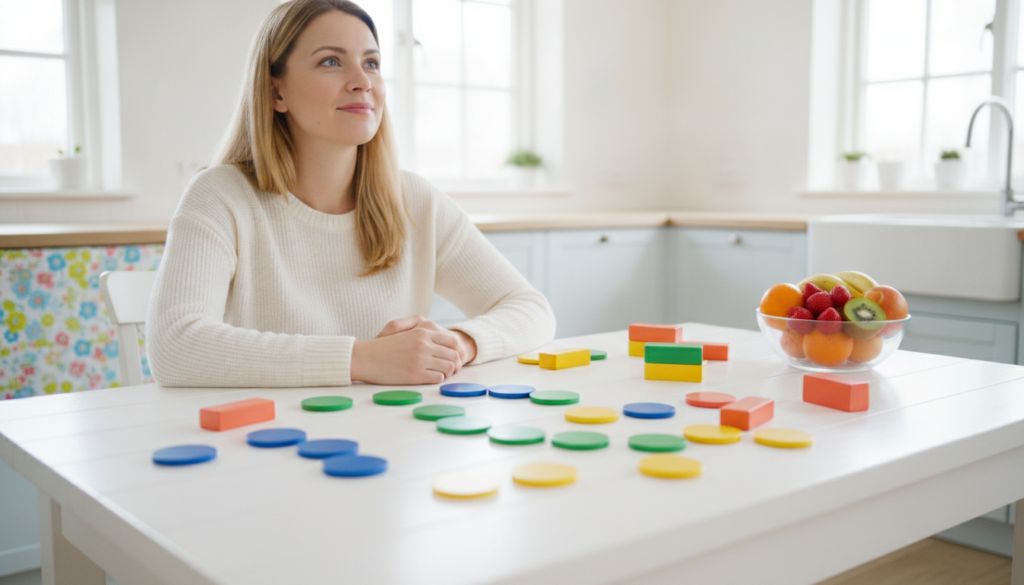
Start by taking the clock out of it. At home, let her finish without a timer, and tell her plainly that fast and smart are not the same thing. Then build the facts in small, concrete ways. Roll two dice and race to say the total, with the dots right there to count. Use a handful of counters to show that eight and seven make the same amount as ten and five. Keep each session to five or ten minutes, and keep it below the level that makes her tense, so she wins more rounds than she loses. These are worked alongside the math she is already learning, not in place of it. Short and steady beats long and tearful. You value a child who believes she is capable, and you are the one person in that room who sees past the clock to the thinker underneath. The system that hands a child a single slow number and lets her read it as a verdict was not built to catch what you catch. That gap is yours to fill. When math is hard, we look at more than the math. Number sense, the steps of a problem, holding a figure in mind while she works. Our assessment asks about all of them, and what comes back names where to start and in what order. See where to start.
Common questions from parents
Is being slow at math a sign of dyscalculia?
Should I stop her using her fingers?
When should I ask for an evaluation?