The reassuring line every parent reaches for is that some people are simply finger counters, and there is nothing to it. The developmental research does not dismiss it that fast, and it does not sound an alarm either.
Finger counting by itself is a normal, useful tool at any age. What earns a second look is whether a child is still leaning on her fingers for the easy sums she has practiced hundreds of times.
Your child is not broken, and her brain is learning to work with numbers in its own way. Noticing this signal in fourth grade is a good thing, not a scary one.
TL;DR
- Finger counting on its own is not a problem at any age. The signal to watch is persistent finger counting on easy, familiar sums a child has already practiced many times.
- Fourth grade is often when this shows up, because math that used to lean on counting now expects quick recall (Jordan and Devlin, 2023).
- This pattern responds to concrete, step-by-step number sense teaching worked right alongside her regular math. It is a skill to build, not a fixed limit.
Finger counting is not the problem. Staying stuck on fingers for sums she should know by heart is the part worth paying attention to.
“– Laura Lurns
What finger counting actually tells you
Fingers are a child’s first calculator, and a good one. Every young learner starts by counting real things, then pictures, then the symbols on the page. Moving off the fingers happens as facts turn automatic, so a quick sum is pulled from memory instead of rebuilt each time. When a child keeps rebuilding 6 plus 3 on her fingers in fourth grade, the counting is doing a job that recall should have taken over. That points at the layer underneath the arithmetic, the number sense that lets a child feel how big a quantity is and how numbers relate to each other. It is one of the core skills of math, and like the others it is taught and practiced rather than a fixed trait. In our experience, children who find it hard build the same math their classmates do, given concrete, step-by-step instruction.
The signal is persistence, not the fingers
Here the research gets specific, and honestly, reassuring. A clinical guideline summary by Haberstroh and Schulte-Korne (2019) spells out that finger counting on its own is not a sign of anything. What counts is persistent finger counting on easy, often repeated sums. It is also errors that stand out by their variety, frequency, and how long they last, not by showing up at all. So one child using fingers now and then is ordinary. A child who rebuilds the same small sums every time, months after her class moved on, is showing you something worth a closer look. This is also why fourth grade is the moment it surfaces. Early grades let counting carry a child, so the difficulty stays quiet, and math difficulty often goes unnoticed until around this age (Jordan and Devlin, 2023). Nothing suddenly got worse. The demands changed, and the old strategy stopped keeping up. A persistent version of this pattern is what specialists call dyscalculia, a difference in how the brain works with quantity. It is present in roughly 3 to 7 percent of people, and the figure shifts by where the cutoff is drawn (Haberstroh and Schulte-Korne, 2019). Want a plain list of what to look for alongside the fingers? The signs of math learning differences lay it out, and show how it differs from plain math nerves. What you are seeing is a mismatch between a slow, effortful method and faster work. That is a description of where she is today, not a verdict on where she is going.
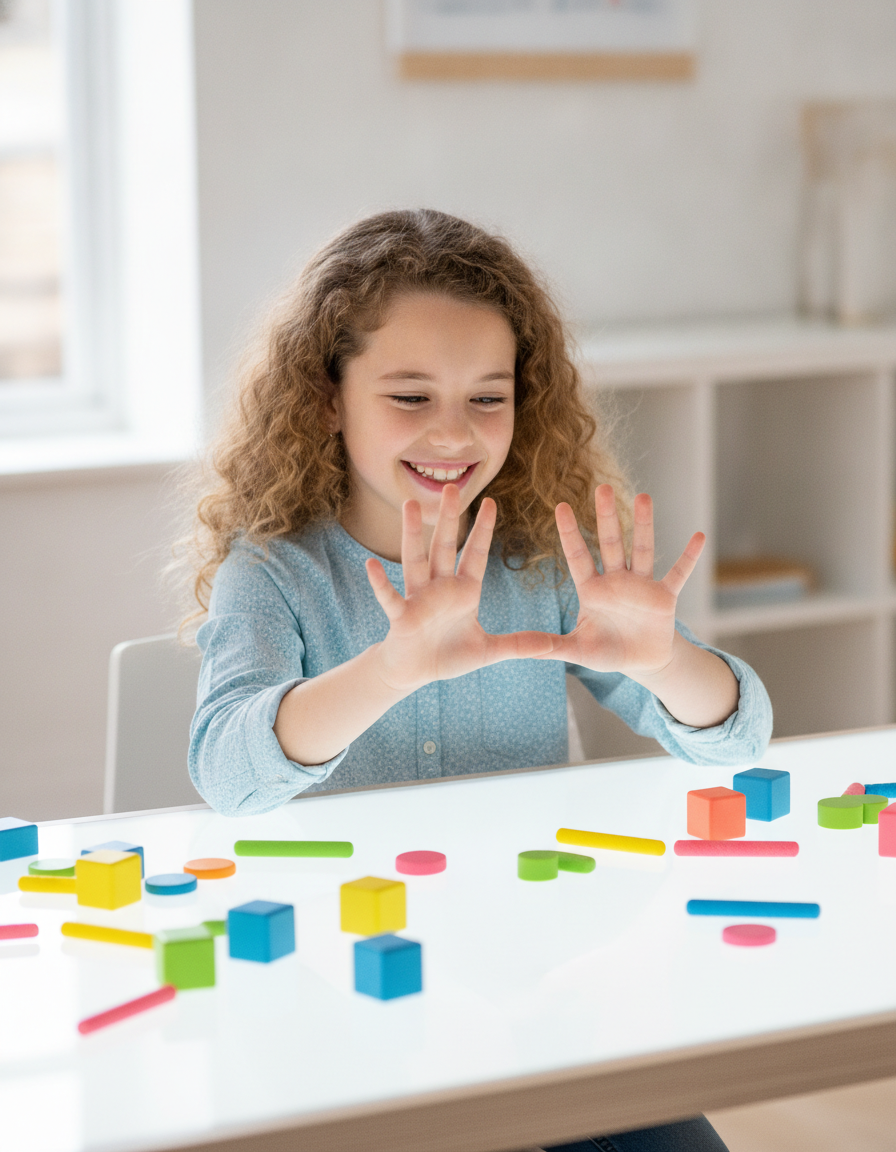
When a parent tells me their fourth grader still counts on her fingers, my first question is never about the fingers. I want to know which sums, and whether she is rebuilding facts she has met a thousand times. When we build the number sense underneath, worked right beside her everyday math, the counting usually fades on its own. She no longer needs it to feel sure of the answer. That is the moment a child stops bracing for math and starts trusting herself with it.
Key Takeaways
Finger counting is a normal math tool at any age. The signal worth watching is persistent counting on easy, familiar sums a child has practiced many times.
Fourth grade is often when this surfaces, because arithmetic now expects quick recall instead of counting. The strategy did not get worse; the demands grew.
A slow, effortful method points at the number sense underneath. Built with concrete, step-by-step teaching beside regular math, it is a skill to grow, not a fixed limit.
A diagnosis describes where your child is today. It does not predict where she will be after a year of the right kind of practice.
“– Laura Lurns
What to do about it at home
Start small and concrete, and keep it beside the math she is already doing. Notice the sums she rebuilds every time and turn them into short, friendly practice: the pairs that make ten, doubles like 6 and 6, then the near doubles. Play with real objects and a number line so a quantity has a size she senses, not a symbol she decodes. Keep sessions brief and warm, praise the thinking rather than the speed, and let her show you how she got there. You know this child better than any form does. The path most families are offered runs the other way. It waits for a struggle to grow big enough to earn a label before anyone acts. That wait costs a child months of feeling like the slow one. You do not have to wait for a name to start helping her today. When math is hard, we look at more than math. The number sense underneath it, holding steps in mind, how she feels when the numbers appear. Our assessment asks about all of them, and turns your answers into a plan for what to build first. Start that here.
Common questions from parents
Is finger counting in fourth grade a sign of dyscalculia?
Why is my daughter struggling with math now, when she seemed fine in earlier grades?
Should I get her tested or evaluated?
What actually helps a child move past finger counting?