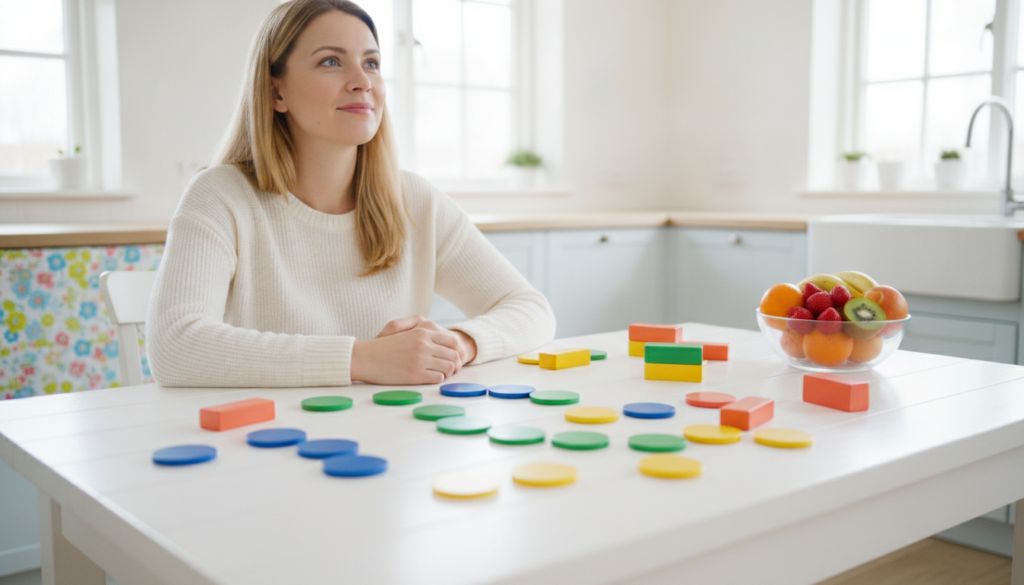
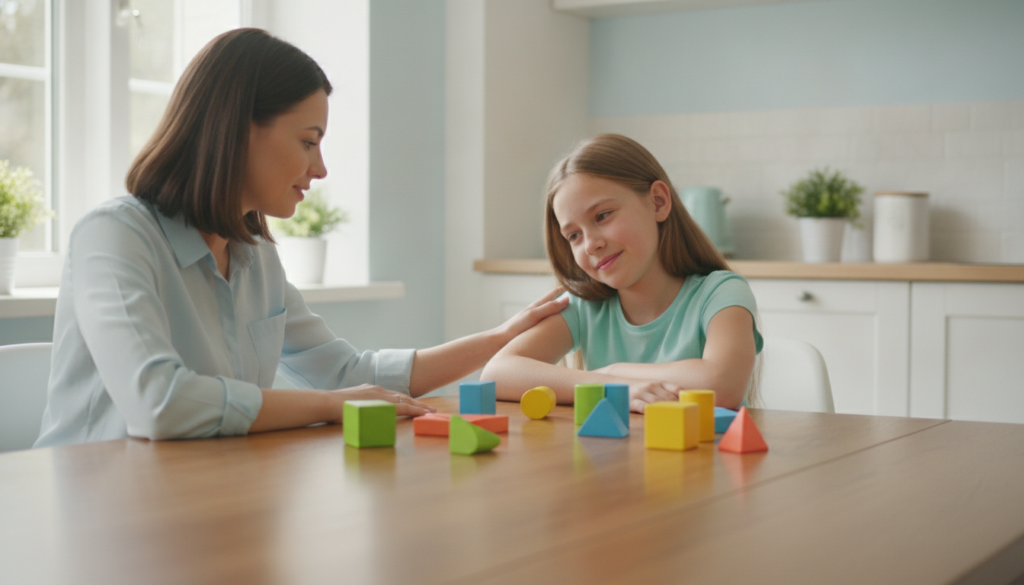
The advice is always the same: more practice, a little more patience, and she will get there. So you sit with her every night, and every night it ends in tears instead of answers.
Here is what that advice misses. When a child is frightened, the fear itself gets in the way of the thinking. The problem was never that your daughter finds math hard. It is what fear does to a brain that is trying to work.
You are not failing her, and she is not broken. Her brain is learning math under a load of fear, and that load is something you are able to lift. Those tears are a stress response. It is the same one anyone has in front of something that feels like a threat. A stress response is something you are able to interrupt and rebuild, step by step.
TL;DR
- Nightly crying over math is almost always a stress response, not laziness or defiance. One brain-imaging study of 7 to 9 year olds found a telling pattern. Math anxiety went with more activity in the brain’s fear center and less in the math-reasoning regions (Young, Wu and Menon, 2012).
- Math anxiety and a math learning difference like dyscalculia are two different things that often sit together. The way to help starts the same. Lower the fear, then rebuild number skills in small, concrete steps she succeeds at.
- You are the person best placed to turn the nightly battle around. You do it by making math feel safe before it feels hard, and by working number sense alongside her math instruction rather than in place of it.
The problem was never that math is too hard for her. It is that fear reaches the thinking before the math does.
“– Laura Lurns
Why the tears come before the math does
When something feels threatening, the body reacts before the thinking brain gets a turn. The heart speeds up, the chest tightens, and attention narrows to the feeling itself. For a child who has learned to dread math, the worksheet is the threat. The reaction fires long before she reads the first problem. To us, those tears are not defiance or drama. They are that same alarm, going off at the kitchen table. Brain-imaging work points the same way. In 7 to 9 year olds, higher math anxiety went with more activity in the brain’s fear center and less in the regions used for number work (Young, Wu and Menon, 2012). Fear is loud, and it crowds out the quiet work of thinking. It also helps to notice whether you are seeing fear, a genuine struggle with numbers, or both. What a number difference looks like day to day is not the same as what fear looks like, and the two often travel together.
More practice is the wrong first move
The instinct is to double down: more drills, more flashcards, more time at the table until it clicks. When fear is the thing in the way, more pressure pours more math onto the fear, and the dread grows. Math anxiety is learned, which also means it is able to be unlearned (Maloney and Beilock, 2012). That is the hopeful part, and it is where the real work starts. It is also worth knowing that fear and a genuine number difficulty are not the same thing. Dyscalculia is a difference in how a child processes number and quantity. It affects somewhere between 3 and 7 percent of people, depending on where the line is drawn, and it often sits alongside anxiety rather than causing it. You do not need to sort out which one it is tonight. What the research says about math difficulty and math anxiety points to the same starting place for both. Make math feel safe first, then teach number skills directly and concretely.

I have sat with a lot of these children, and the pattern is almost always the same. The moment the fear comes down, a child who ‘could not do math’ starts doing math, because the thinking was there all along, pinned under the alarm. So I never start with the numbers. I start by making the table a safe place to be wrong, and I build from the first small thing she gets right.
Key Takeaways
Tears over math are a stress response, not a character flaw. Fear fires before thinking, and no amount of ‘it is not that hard’ reaches it.
Pushing more practice into the fear makes the dread stronger. Lower the fear first, then teach number skills in small, concrete steps she succeeds at.
Math anxiety is learned, which means it is able to be unlearned. Your calm presence at the table is one of the strongest tools for that.
You are not the backup plan here. A calm parent beside a frightened child is the thing that turns the nightly battle around.
“– Laura Lurns
What to do when the clock hits homework time
Start before the numbers. For a few nights, take the pressure all the way off: no worksheet, no right answers, nothing to finish. Count stairs together, roll dice and race to say the total, split a cookie into equal pieces. You are showing her brain that numbers and safety are able to sit in the same room. When she is calm, bring in short, concrete practice, worked alongside her math instruction rather than in place of it, and stop while she is still winning. Here is what you are up against, and it is not your daughter. It is a system that is quick to label a struggling child and slow to ask what is actually in her way. You know her better than any form does. You see the fear, you see the moments it lifts, and you are with her every single night. That is not a weakness in the system. It is the reason your involvement is the thing that matters most. When math is hard, we look at more than math. The fear, the number sense, the confidence that drains away after a bad night. Our assessment asks about all of them, so you start with the whole child rather than the loudest symptom. If you want a clear place to begin, start here with a free 7-day All Access trial.
Common questions from parents
How do I tell the difference between math anxiety and dyscalculia?
Should I let her use her fingers or a number line?
Will pushing through the tears help her get used to it?
How common is dyscalculia?