
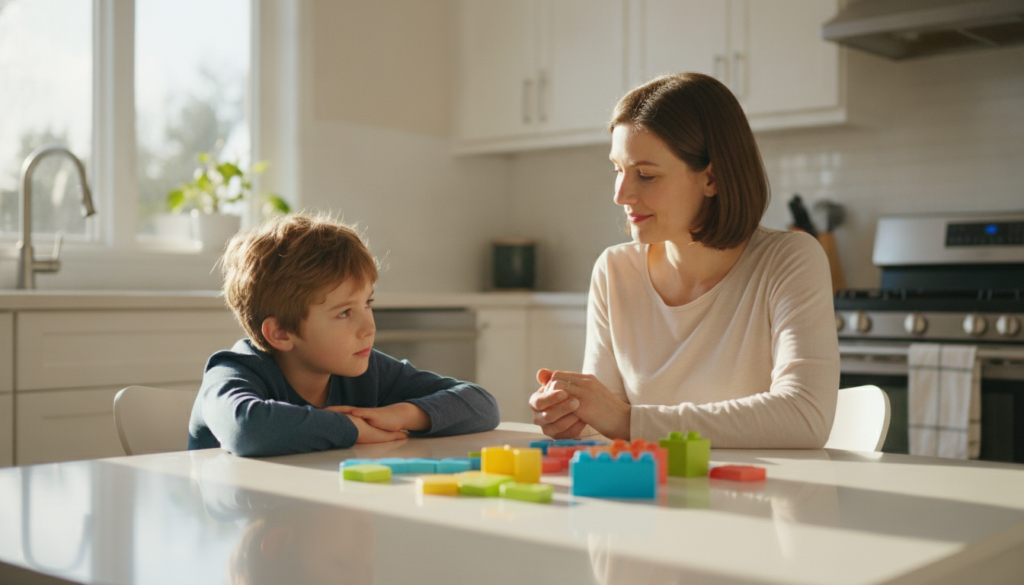
The report says he knows it. The star is right there on the page, and the teacher meant it. So when he sits down at home and the same thing gets a blank stare, it is easy to read it as defiance.
Here is the reframe most parents never hear. What looks like a child choosing to be difficult is almost never that. It is a gap between what he does in one place and what he does in another. That gap is a signal about how he processes, not a flaw in who he is.
Your child isn’t broken. His brain is learning differently. And the place you are seeing him struggle is the place you have the most power to help.
TL;DR
- A child who knows it at school but goes blank at home is almost never doing it on purpose. School surrounds him with support that quietly carries part of his performance, and at home that support falls away.
- What you see at home is his real starting point at the end of a long day, when he has the least left to give. It is a signal about processing and energy, not a character flaw.
- Home is where you have the most leverage. Lower the load, pick a better time, and build the skill in small steady steps instead of treating the gap as a discipline problem.
A performance gap is a processing signal, not a character flaw.
“– Laura Lurns
What You Are Actually Seeing
At school he is not performing alone. A teacher prompt. The routine. A glance at the child next to him. The room that means work happens here. All of it props up his performance in ways nobody writes on the report. Take that scaffolding away and you see what he does without it. That is not a smaller child than the one at school. It is the same child, minus the supports. One system doing heavy lifting here is working memory, the skill of holding steps in mind while he uses them. It is one system among several. When it is stretched thin, the steps fall out of his head between hearing them and doing them.
Why It Looks Like He Is Choosing This
The quiet fear is that a bright child who does it at school and not at home has to be choosing it. For years the field leaned the same way. It treated a capable child who struggles as a puzzle that needed explaining. That has shifted. In 2025 the International Dyslexia Association updated its definition of dyslexia. It dropped the old line that difficulty is unexpected in a bright child. Catts and colleagues (2026) spelled out why: the gap between ability and performance does not predict much. A capable child who falls apart on the same task is the expected picture, not proof of bad character. Timing makes it sharper. This is what we watch happen in family after family. Homework lands after a full day of holding it together, when he has the least left to give. If evenings are the hard part, a short practical read on steadying attention before homework is a gentler first move than a battle.

When a parent tells me their child knew it at school and lost it at home, I feel relief for the child. I have watched this pattern for years, and it is almost never defiance. What I look for is the load. How much was he holding? How tired was he? How much of the school version was carried by the room around him? When we lower that load and build the skills underneath in small steps, the home version starts to look a lot more like the school one. The child was never the problem. The conditions were.
Key Takeaways
A performance gap between school and home is a signal about processing and energy, not about character. Reading it as defiance makes the evening harder and hides what is going on.
School performance is partly propped up by prompts, routine and other children. What a child does at home, without those props, is closer to his true starting point.
The end of the day is the worst time to judge what a child knows. Lower the load, pick a better time, and build the skill in small steps he does not have to fight.
You do not need a credential to be the most important teacher your child will ever have. You already are one.
“– Laura Lurns
What To Do at Home Tonight
Start by taking the pressure off the moment. Move homework earlier when you are able, before he is running on empty. Let him move his body for ten minutes first, so he arrives with something in the tank. Shrink the task until the first step is too small to fight. Name what he is doing out loud: you are getting better at sticking with something hard. Notice the effort, not only the finished page.
You value a child who feels capable, not one who learns to perform for a room and fall apart out of it. The system he is in is built to sort children into labels and hand back a name. What he needs is someone who lowers the load and teaches the skill underneath. That someone is you. You are already the most important teacher he will ever have, and the place he struggles most is the place you reach him best.
A home performance gap rarely travels alone. Most children who go blank at the kitchen table are also carrying a focus and attention load and a stretched working memory. The two often show up together at the end of the day. Learning Success All Access starts with a set of questions about what you see at home, then builds a plan around the whole child rather than one symptom. The plan is yours to keep whichever way you decide after the trial. Start the seven-day All Access trial here: learningsuccess.ai/all-access.
Common questions from parents
Is my child doing this on purpose?
Why does he do fine at school but fall apart at home?
Should I get him evaluated?
How do I help him at home without making it a battle?

