
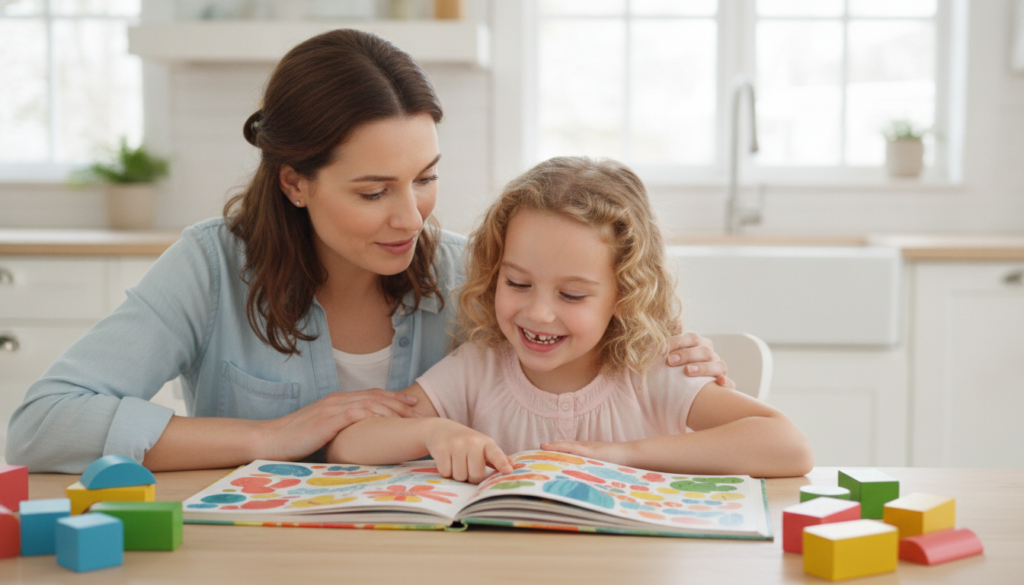
Is she reading, or putting on a show? You have half-typed that question into a search bar late at night, then deleted it before anyone could see. Asking it out loud feels like accusing your own child of faking.
Here is what you have seen that the others have not. She holds the book the right way. She turns the pages on cue and recites with expression. To her teacher and her grandparents, she looks like a reader. Then you sit beside her on a page with no pictures, and the whole thing comes apart.
She is not trying to fool you. She is working harder than anyone in the room to look like the thing no one has taught her to do yet. The words ‘I am bad at reading’ are a prediction she is making about her own future. The show is how she keeps it hidden.
TL;DR
- When a child pretends to read, she is not faking. She leans on a sharp memory, picture cues, and the shape of words she knows by sight to rebuild a page she is not yet able to sound out. It is a coping strategy, and it hides a gap in connecting the sounds in a word to its letters.
- The performance looks a lot like what guessing-based reading methods teach on purpose. Approaches that have children predict words from pictures and the sentence around them train a child to look like a reader instead of becoming one. That is why the show falls apart the moment the pictures are gone.
- A child’s brain changes with the right practice. The way forward is direct, explicit teaching in how sounds map to letters, worked alongside the other skills reading leans on. The skill she is performing is the exact one you get to help her build.
She is not performing to fool you. She is working harder than anyone in the room to look like the thing no one has taught her to do.
“– Laura Lurns
What the Performance Is Actually Made Of
A child who pretends to read is running three workarounds at once. She memorizes whole pages after hearing them once or twice. She reads the pictures instead of the print. And she guesses the next word from the shape of the sentence. Put together, it looks like reading. What it hides is the part of reading that has to be taught. That part is linking the sounds in a spoken word to the letters on the page. This is the difficulty at the center of dyslexia. For many children it shows up as trouble turning sounds into print, long before anyone says the word out loud. Her memory is a strength, and that is the reason the cover holds. The stronger the memory, the longer the gap stays out of sight.
Why the Show Looks So Much Like Reading
Here is the part that stings. The performance is not something your daughter invented on her own. It mirrors a method many classrooms still use to teach reading. In that method, children are taught to work out a word from the picture, the first letter, and the rest of the sentence. Eye-tracking research by Keith Rayner shows that skilled readers do the opposite. They look at almost every word in turn, skipping mainly the short and predictable ones. Literacy researcher Timothy Shanahan calls guessing from context how poor readers read, not strong ones. In a 2019 survey, three in four early-grade and special-education teachers said they teach the guessing method anyway. The journalist Emily Hanford laid this out in her 2019 series Sold a Story, and states are still passing laws to correct it. So when the pictures disappear and the show falls apart, your daughter is not failing. She is doing exactly what she was taught, and running out of road. If you want to see where this comes from, the research we hold on reading lays it out.

When a parent tells me their child ‘reads’ but something feels off, this is almost always what I find. A sharp memory doing the work that decoding should be doing. The performance itself never worries me. It tells me the child is capable and willing to work. The part that matters is teaching the sound-to-letter skill head on, so the child stops needing the cover.
Key Takeaways
Pretending to read is a coping strategy, not deception. A strong memory and picture cues hide a gap in connecting sounds to letters.
The performance falls apart when the pictures are gone, because guessing from context is how struggling readers get by, not how strong readers read.
The gap is teachable. Direct, explicit teaching of sound-to-letter links, alongside the other skills reading leans on, builds the real thing.
The skill she is performing is the exact skill you get to help her build.
“– Laura Lurns
What to Do, Starting Tonight
Tonight, try one small thing. Pick a short page with no pictures and read it together, pointing to each word as you both say it. Watch where she slows down or guesses. You are not testing her. You are learning where the gap sits. The villain here is not your daughter, and it is not you. It is a method that taught her to perform instead of read, and a school system slow to let it go. No one will advocate for her the way you will. That is true of every system, everywhere, and it is why your part in this is the thing that moves it. When reading is hard, we look at more than reading. The sounds, the page, holding words in mind. Our assessment asks about all of them, and it turns what you have noticed into a plan for what to build first. You get a clear next step here: start your child’s plan.
Common questions from parents
Is pretending to read a sign of dyslexia?
My child has a great memory. Why would she struggle to read?
Should I get my child tested?
What is the guessing method, and did my child’s school use it?