

The report calls it a handwriting problem. The pencil is where you see it, but the pencil is rarely where it begins.
Your child dictates elaborate stories and explains ideas most adults would fumble. The thinking is not in question. Something between the idea and the page is stalling, and neatness drills have never touched it.
When a child thinks well and struggles to get it down, the gap is almost never intelligence. It is the hand, and the systems working underneath the hand.
TL;DR
- When a child thinks well but struggles to get words on the page, the problem is rarely intelligence or effort. It is usually fine motor coordination and the processing skills beneath it, and those build with practice.
- Fine motor control rests on gross motor foundations: core strength, shoulder stability, and bilateral coordination. Handwriting struggles often trace back to these, not to the fingers alone.
- Forming letters by hand strengthens neural pathways that also support reading. Building the skill is worth more than working around it.
The pencil is where you see the struggle. It is almost never where the struggle starts.
“– Laura Lurns
The gap between a bright mind and a stuck pencil
A child who tells whole stories out loud and then freezes over a short paragraph is showing you one thing. The ideas are intact. The block sits in the machinery that turns thought into motion. Handwriting asks the brain to hold an idea, plan the strokes, and steer small muscles, all at once and at speed. When the motor part is hard, it eats the focus the child needs for the idea, and the output falls apart. Strengthening fine motor skills is not cosmetic. It frees up the mental room a child needs to think and write at the same time.
Handwriting is built from the shoulder, not the fingertips
Here is what neatness drills miss. Fine motor control rests on gross motor foundations: core strength, shoulder stability, and bilateral coordination. A child who slumps to hold up their own trunk has little left for finger control. This is why movement and proprioception, the body’s sense of itself in space, sit upstream of a legible page. And the practice pays off twice over. Brain-imaging work by Karin James and Laura Engelhardt in 2012 found that forming letters by hand activates letter-recognition and reading circuits in a way that typing and tracing do not. The hand teaches the eye. Building handwriting builds reading at the same time.
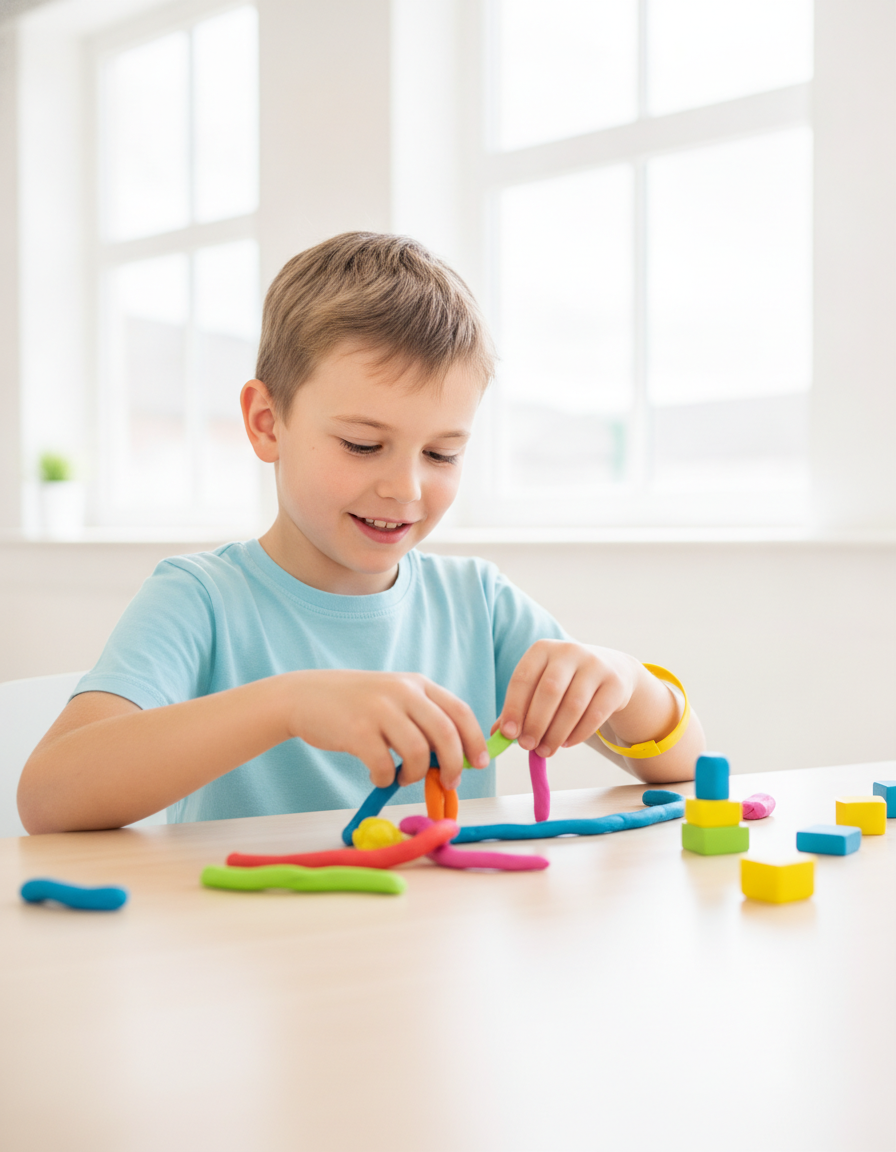
When a parent shows me a child who talks like a novelist and writes like it hurts, I stop looking at the paper. I look at how they sit, how they cross the midline, how steady the shoulder is. Nine times out of ten the fingers are the last link in a longer chain. We strengthen the chain from the core outward, and the handwriting starts to catch up to the mind that has been waiting for it.
Key Takeaways
A child who thinks well but writes with difficulty is showing a motor and processing bottleneck, not a shortage of intelligence.
Fine motor skill is built from the core and shoulder outward. Gross motor foundations come before fingertip precision.
Forming letters by hand strengthens reading circuits. Building handwriting is worth far more than working around it.
Your child’s mind has been ready for a while. The work is helping the hand catch up, not lowering the bar it has to reach.
“– Laura Lurns
Build the hand instead of shrinking the assignment
You value a child who gets to show what they know, and you see the ideas waiting to come out. The system’s reflex is to cut the writing, hand over a keyboard, and call it solved. Sometimes a tool is the right scaffold. Still, it is worth asking the real question about any support: is this building the skill, or quietly replacing the expectation that it gets built? Start upstream with short daily practice for core stability, bilateral coordination, and hand control. The Brain Bloom program targets these motor and processing skills in small, parent-led sessions. And handwriting struggle rarely travels alone. Many children who fight the pencil also show signs of weak visual tracking or shaky working memory. A free 7-day trial of All Access gives you an AI assessment that names which skills to build and a 12-week plan for each day.
Common questions from parents
Does messy handwriting mean my child has a writing disability?
Should I let my child type instead?
Where do fine motor skills actually come from?
Will handwriting improve, or is it fixed?