

The phrase sounds like a settled fact. She is a words girl, not a numbers girl. It explains the grades, it sets expectations, and it quietly tells her that struggling with math says nothing about how bright she is.
Here is the part the phrase hides. It treats the gap as a personality, and a personality has no path forward. A way of processing numbers does. Your child is not broken. Her brain is learning math differently, and that is a different problem with a different ending.
A wide gap between words and math is one of the recognized early patterns in how children learn number. It points at a handful of skills, not at a fixed limit. Once you see what is driving it, the story stops being about who she is and turns into what to teach next.
TL;DR
- A wide gap between strong words and weak math is usually a skills pattern, not a fixed type and not a verdict on how bright your child is. The piece that tends to be thin is number sense, the feel for quantity, and it is teachable.
- Being strong with language and weaker with math is a known profile, not proof she is lazy or not trying. Verbal reasoning and math reasoning are different skills, and one being strong does not make the other automatic.
- The path forward is teaching number sense directly, in small concrete steps, worked alongside her math instruction rather than in place of it. The feelings that grow around math, like dread and avoidance, need their own attention at the same time.
A personality has no path forward. A way of processing numbers does.
“– Laura Lurns
What the words-numbers gap is actually made of
When a child reads well, talks easily, and tells a story with color, a struggle with math looks like a contradiction. It is not. Verbal skill and math skill run on different equipment, and a child often has a lot of one and less of the other.
The piece that tends to be underbuilt is number sense, the quiet feel for quantity. It is what lets a child sense which amount is bigger. It is seeing how many sit in a small group without counting one by one. And it is connecting the symbol on the page to the amount it stands for.
When that feel is thin, every later step, from arithmetic facts to place value, costs more effort, because the ground underneath is still soft. This is a skill that gets built, not a talent a child is born with or without.
She is bright. That was never the puzzle.
Here is the myth worth retiring: that a bright child who is bad at math must be coasting or not trying. A wide gap between words and math is one of the recognized early signs of a math learning difference, sometimes called dyscalculia. Being strong with language and weaker with math is an expected shape of it, not a reason to doubt your child’s effort or her mind.
Intelligence is not the thing in question. For years, a child who struggled at one subject but shone at another got read through a discrepancy lens, as if the mismatch itself were the finding. The field has moved away from that. When researchers tested IQ-discrepancy approaches, they held up poorly as a way to predict who needs help. Catts and colleagues (2026) found they ‘lack predictive validity’.
What that leaves is simpler and kinder. Your daughter finds math hard because specific number skills are still thin, and thin skills get thicker with the right teaching. To us, nothing you have described sounds like a child who is not trying.
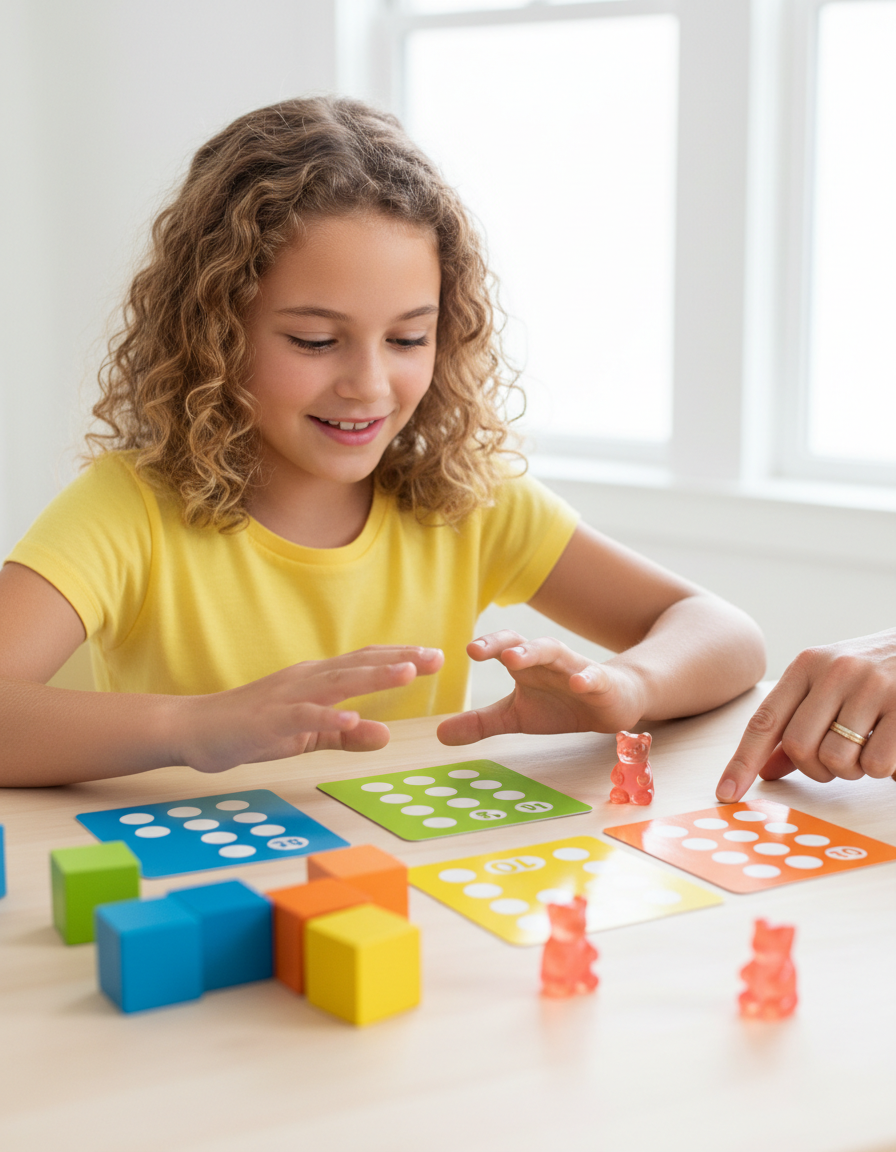
When a parent tells me their child is a words kid and not a numbers kid, I look first at number sense. That is the quiet feel for quantity underneath the arithmetic. It is almost always thinner than the child’s age would predict, and almost always teachable. I watch for the moment a child stops reaching for her fingers on a small sum and simply knows the answer. That moment looks small, and it is the whole game. It tells her that math is something she gets better at, not something she is or is not.
Key Takeaways
A wide split between strong words and weak math is usually a skills pattern, not a personality and not a measure of intelligence. The underbuilt piece is often number sense, the feel for quantity, and it is teachable.
A bright child who struggles at math is the expected picture of a math learning difference, not a contradiction. The old habit of reading the mismatch as laziness does not hold up.
Teach number sense directly and in small concrete steps, worked alongside her math instruction rather than in place of it. Give the feelings around math, like dread and avoidance, their own attention at the same time.
A diagnosis describes where your child is today. It does not predict where she will be after a year of the right kind of practice.
“– Laura Lurns
What you do with this at home
Start by shrinking the amount of math that ends in failure each day. Count how often she hits a wall, then make the encounters fewer, shorter, and better aimed, rather than easier. Work at the level where she needs a strategy and some effort to succeed, because success below that line teaches her nothing she believes. Bring quantity back to something physical and touchable. Use counters, dot cards, and real objects, so the amount and the symbol stay joined while number sense fills in. This is the foundation worked alongside her math instruction, not a replacement for it. Keep a piece of her work from a month ago, so she, not you, is the one who notices she has moved.
You already know your daughter is bright. You have watched her mind work. What you were handed is a story that turns one hard subject into a fixed type. It comes from a system that would rather label a child than teach the skill underneath. You are the person who refuses that trade. A name for where she is today does not decide where she lands after a year of the right practice.
When you are ready to see the whole picture rather than one subject, this is where to start. When math is hard, we look at more than math. Number sense, the feel for quantity, how math has come to feel, and the attention and memory a problem leans on. Our assessment asks about all of them, and turns your answers into a personalized plan you start this week.
Common questions from parents
Does a wide gap between words and math mean my child has dyscalculia?
How common is this kind of math difference?
Is my daughter simply not a math person?
Should I pull back on helping with math homework?