

There is a boy who reasons his way through a strategy game most adults would lose, then freezes when the worksheet asks him to add seven and eight. His report card tells one story about him; the game tells another.
If “he has never been great at math” has become something you say without thinking, you are not careless, and neither is he. You reached that line after years of effort that did not pay off.
But a low math grade only describes where a child is today. It does not predict where he lands after the right kind of practice.
TL;DR
- Struggling with math says nothing about how capable your child is. Math is a skill set built through concrete, step-by-step teaching, not a talent you are born with. Children who find it hard learn the same math, often by a different route and with more practice.
- A math difficulty and a fear of math are two different problems, and they often travel apart. One needs better teaching. The other needs the dread taken seriously in its own right.
- The useful question is not whether your child is a “math person.” It is which specific skill has a gap, and what to build first.
A low math grade tells you where a child stands today. It was never a measurement of the ceiling.
“– Laura Lurns
What “Bad at Math” Is Actually Made Of
Math looks like one subject on a report card. Up close, it is several separate skills working together. There is number sense, the gut feel for how big a number is and whether an answer is even close. There is holding the steps in mind while you work through them. There is keeping figures lined up on the page and tracking where you are. And underneath all of it sits what the child has decided math says about him. When a child stalls, the block is usually in one or two of these pieces, not in the child. To us, a boy with no reliable feel for quantity is not a lazy boy. He is a boy doing every problem the slow way, without the one tool that would make it quick. Relabel the report card and nothing changes. Find the skill with the gap and you finally have somewhere to start.
A Math Difficulty and a Math Fear Are Not the Same Thing
Some children have a real, specific difference in how the brain handles numbers and quantity. It has a name, dyscalculia. It affects roughly 3 to 7 percent of people, and the exact figure moves depending on where the line is drawn (Haberstroh and Schulte-Korne, 2019). Here is the part the word “bad” hides: it is not a wall. Butterworth, Varma and Laurillard (2011) describe dyscalculia as a difference in processing quantity that gets stronger with targeted, well-designed teaching. A feel for quantity is built, not issued at birth. Other children have no math difficulty at all. What they have is fear. Brain-imaging of math anxiety in young children found something telling. It fires the brain’s fear response, the same circuitry behind other worries, and quiets the regions used for reasoning (Young, Wu and Menon, 2012). Our reading is plain: the trouble there is fear, not ability, and more drilling in the thing he dreads does not settle it.
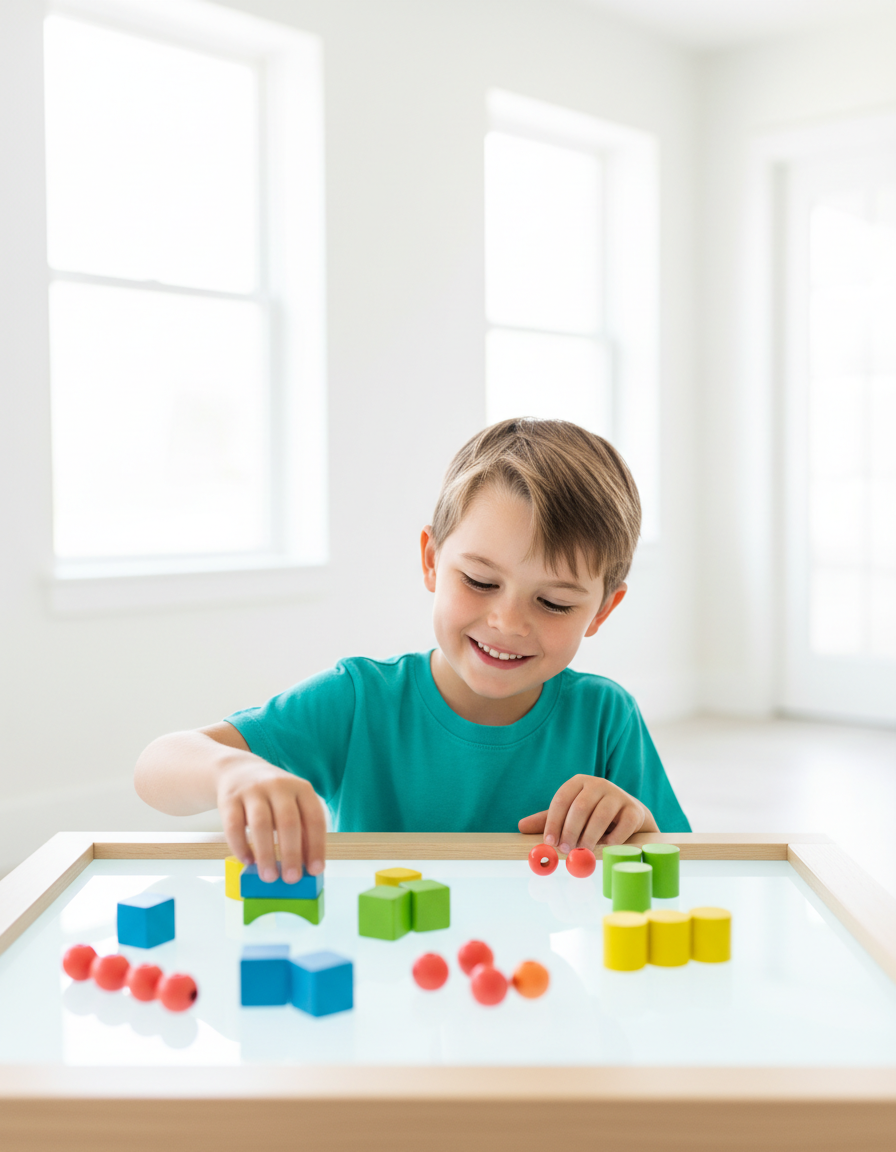
When a parent tells me a child has always been bad at math, I stop reading the grade and start looking at the pieces underneath it. In the children I work with, the struggle usually traces back to something specific. It is a shaky feel for quantity, or a fear that fires before the pencil even moves. Name that piece, teach it directly, and I watch the child slowly stop matching the label someone wrote on the folder.
Key Takeaways
“Bad at math” describes a grade, not a child. It does not tell you which skill has the gap, and that gap is the thing worth finding.
A math difficulty and a fear of math are different problems. Work out which one you are looking at, because they call for different help.
Children who find math hard learn the same math as everyone else, often by a different route and with more practice. That route is teachable.
Your child was never the problem to be worked around. The gap in the teaching was.
“– Laura Lurns
Where to Start
Start by counting, for a week, how often your child runs into math and fails. Then bring that number down. That is not lowering the bar; it is changing how often the belief gets fed. Fewer, shorter, better-pitched sessions beat long ones that end in tears. Say what will be in a session before it starts, so the dread has less unknown to feed on. And keep one piece of his work from a month ago, so he has proof, in his own hand, that something shifted. Number-sense games, comparing amounts or spotting which pile is bigger, are worth doing alongside the math he is taught, not in place of it. You already know your son is more than a grade. You have watched him reason and argue and figure things out, everywhere except the one subject a label got stuck to. A system was quick to name what he could not do and slow to ask why. That question, the why, is the one that leads somewhere, and nobody is going to chase it as hard as you will. When math is hard, we look at more than math. The number sense, holding the steps in mind, how math has come to feel. Our assessment asks about all of them, and turns your answers into a plan you start this week.
Common questions from parents
Is my child lazy, or is something making math hard?
What is dyscalculia, and does my child have it?
My child freezes on tests but seems fine at home. Is it dyscalculia or something else?
How do I help without making it worse?