
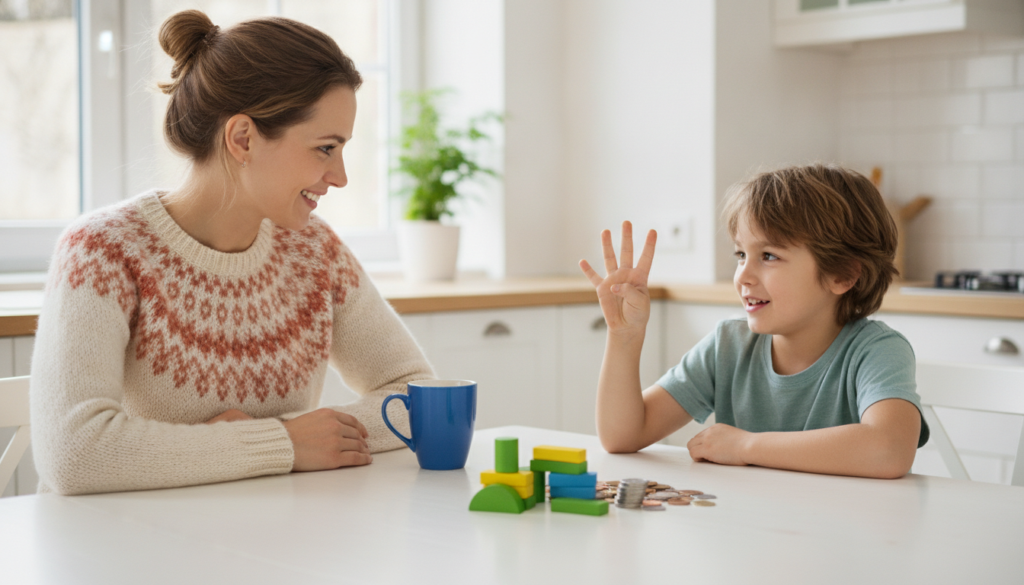
In 2019, two German researchers set out the clinical guideline for children who struggle with math (Haberstroh and Schulte-Körne). One line in it belongs on your fridge: finger counting on its own is not a sign of dyscalculia. It is a normal aid while a child learns math facts.
The sentence that came with the fingers is the harder part. “I’m dumb at math” is not a description. It is a prediction your child is making about their own future, and every session either confirms it or quietly rewrites it.
TL;DR
- From one evening at home, nobody sorts dyscalculia from a teaching gap, and you don’t need to. The first step is the same for both: teach the fact your child counts out with objects, then a drawing, then the numbers.
- How your child responds to clear, concrete teaching over the next few weeks is the real evidence. US federal rules and the ICD-11 manual both rule out a lack of teaching before they name a math disability.
- Fingers are fine. The pattern to watch is counting on easy, often-repeated sums that never start to come from memory. Keep a short log and take it to school with two questions.
Fingers are not the warning sign. Easy sums that have to be counted out from scratch, every night, for weeks, tell you more.
“– Laura Lurns
Fingers are a tool. Easy sums tell you more.
Fingers help children learn early math. The same German guideline calls finger counting a normal aid while children learn math facts and quicker ways to calculate. So please don’t ban them tonight.
What the German guideline flags is narrower. It is a child who keeps counting on easy sums they have met many times. Each fact gets worked out again from the start instead of remembered. The child stays with counting and doesn’t shift to quicker ways, like knowing 4 + 4 is 8 and using it for 4 + 5. That pattern points to a gap in number sense, the feel for how much a number stands for. Errors count by their variety, how long they last and how often they come, not by one bad night.
Here is the honest part. That pattern does not tell you why. Mazzocco and Räsänen (2013) describe math difficulty as something that changes over time, with the learning environment as part of the picture. In a study that followed children from kindergarten, difficulty that persisted, not one low score, carried the risk (Morgan, Farkas and Wu, 2009). Both point the same way. To tell a teaching gap from something deeper, teach clearly and see what happens.
The law works the same way. In the US, federal rules say a child must not be found to have a disability when the main reason is a lack of proper math teaching (34 CFR 300.306). The World Health Organization’s manual, ICD-11, also rules out a lack of access to education first. Both ask whether the child was taught. Neither asks whether the child is capable.
The real trouble: symbols and speed before the quantity
Here is a system failure worth naming. A child gets written sums and timed fact sheets before they have a sense of the quantity behind each number. The symbols have nothing to attach to. So the child does something sensible. They count.
The federal practice guide for schools (Fuchs and colleagues, 2021, What Works Clearinghouse) sets out the opposite order for children who need extra help in math. The guide rates its evidence for this as strong, for school intervention from kindergarten to grade 6. It calls for real objects and drawings, linked to the written numbers. It calls for fact strategies, such as doubles and making ten, before any timed practice. The guide says timed activities should not be used to introduce a concept, and its panel adds that timed worksheets alone do not build fluency.
These are school studies, so they don’t show what works at home. They do show what good teaching looks like, and you are free to borrow the idea.
Slow facts are also not the same as weak math. Jordan, Hanich and Kaplan (2003) found that for some children, recalling facts was a specific, lasting difficulty, while their progress on story problems was normal. A child who counts out 7 + 3 might still reason well about what a problem is asking.
So, “dumb at math”? Nothing about counting on fingers looks like a lack of brains to us. To us, it looks like a child using the one tool that has worked for them. The facts might never have been tied to a quantity they understand. You’ll find the studies behind this in our summary of the math research.

When a parent tells me their child counts on fingers, my first question is which sums. Counting out 8 + 7 is one thing; counting out 2 + 2 every night for weeks is another. So I teach one fact with objects, a drawing and the numbers, and I watch whether it starts coming back without the fingers. What I notice changing first is the child’s face, before the speed.
Key Takeaways
Finger counting on its own is a normal aid. Counting on easy, often-repeated sums that never come from memory is the pattern worth watching.
Nobody sorts dyscalculia from a teaching gap in one evening. A few weeks of clear, concrete teaching, and how your child responds, is what sorts it.
Teach one fact with objects, then a drawing, then the numbers. Keep it to about ten minutes, end on a success, and log what happens.
You don’t need a credential to be your child’s first teacher. You already are one.
“– Laura Lurns
What to do this week: one fact, three steps, ten minutes
Pick one fact tonight. Choose a sum your child counts on their fingers every time. A make-ten fact like 7 + 3, or a double like 6 + 6, works well.
Step 1, objects. Put out real things: coins, dry pasta or blocks. Your child builds 7, then builds 3, and pushes them together. Count the whole group once, together. Then swap the groups and do it again.
Step 2, a drawing. Put the objects away and draw the same sum as dots. Seven dots, three dots, and a circle around all ten. Your child draws the next one.
Step 3, the numbers. Write 7 + 3 = 10 under the drawing. Point from each number to its group of dots. Then cover the drawing and ask for the answer. If the fingers come out, let them, then go back to the dots.
Stop on a win. About ten minutes is plenty. End on a sum your child gets right. Then name what they did: you built it, you drew it, and you knew it.
What to say when your child calls themselves dumb at math. Try this: “I don’t see someone who’s dumb at math. I see someone who’s building their math understanding. This fact hasn’t been shown to you in a way that sticks. That’s a teaching job, and tonight it’s mine.” Say it calmly, then start the dots.
Keep a three-week log. After each session, write one line. Note the fact, whether your child counted it out or knew it, and how they felt. Stay with the same fact for a few nights, then add the next one.
Take the log to school with two questions. Ask first: “Will you make sure my child’s math instruction moves from objects, to pictures, to symbols, in that order?” Then ask about screening. Federal guidance from 2009 recommends that schools screen all students in math, so ask whether your child was screened and what it showed.
Know when to ask for an evaluation. Ask the school in writing if a few weeks of clear, concrete teaching leaves the easy facts counted out from scratch every time. Ask too if math difficulty runs in your family. In the US, a school evaluation is free to your family, and you don’t have to wait for the log to finish. A professional evaluation is the route to formal support such as an IEP or 504 plan. It is also the step to take if you suspect a vision, hearing or medical cause.
You want a child who stops calling themselves dumb and starts trusting their own head. Our view is that the villain here is an order, not a person. Symbols and speed get handed over before the quantity is there. Then a label gets pinned on the child when it doesn’t stick. You get to change that order at your own kitchen table, ten minutes at a time. You don’t need a credential to be your child’s first teacher. You already are one.
When math is hard, we look at more than the math. The feel for quantity, holding steps in mind, focus and confidence. Our assessment asks about all of them, and anything the roadmap suggests runs alongside your child’s math instruction, not in place of it. Start with All Access here.
Common questions from parents
Is counting on fingers a sign of dyscalculia?
How do I tell dyscalculia from poor math teaching?
What should I say when my child says they’re dumb at math?
Should I stop my child from using their fingers?
When should I ask the school for an evaluation?