
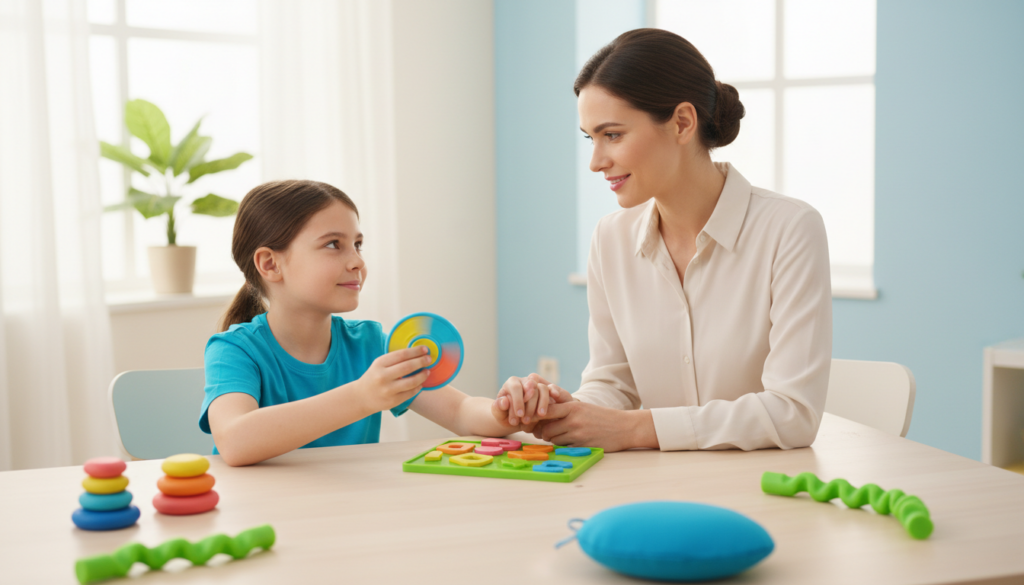
The stare arrives mid-sentence. One moment your child is with you, tracking every word, and the next they are gone somewhere else entirely, eyes open, mind offline. You say their name twice before it lands.
Your child is not broken, and those gaps are not defiance or daydreaming laziness. They are moments when the attention system, still under construction, drops the thread for a beat.
If the coming and going wears you down, here is the part worth holding onto: the inconsistency is not the problem. It is the clue. A skill that works sometimes is a skill that is developing, not one that is missing.
TL;DR
- When your child stares into space and checks out, it is usually the attention system briefly dropping the thread, not defiance or daydreaming. The gaps come and go because the skill is still developing.
- The inconsistency is the clue, not the problem. Attention that works sometimes is a skill in progress, and skills in progress get stronger with the right practice.
- Focus is trainable. Movement, clear structure, and short, successful bursts of concentration build attention stamina more than pressure or a fixed label ever could.
The coming and going is not proof your child could focus if they wanted to. It is proof the skill is still being built.
“– Laura Lurns
What Is Actually Happening in the Gaps
Picture the attention system as a spotlight the brain has to hold steady on one thing while dimming everything else. In a developing brain, that spotlight flickers. It drifts when a task runs low on stimulation, when working memory fills past its limit, or when the body has been still too long and is quietly starved for movement. The stare you see is the spotlight sliding off the page. It is not a decision your child made. Stanford research shows attention and executive function are highly trainable throughout childhood, which means the flicker is a skill mid-development, not a fixed trait. Naming it that way matters, because a child who hears ‘you never pay attention’ learns helplessness, while a child who hears ‘your focus is getting stronger’ keeps building it. If you want to strengthen the skills underneath that spotlight, the foundations of focus are trainable one layer at a time.
Why ‘He Could Do It If He Wanted To’ Gets It Backward
The most common trap is this: he focuses fine on the things he likes, so the problem must be motivation. But interest changes how much stimulation a task provides, and stimulation is fuel for a developing attention system. A game floods the spotlight with input, so it holds. A worksheet does not, so it drifts. That is not your child choosing to try hard for fun and slack off for schoolwork. It is the same under-built skill meeting two different fuel levels. This is why a fixed label reads the situation wrong. Calling it a deficit freezes a moving target in place. The more useful truth is that the body and brain build attention together. Movement primes the brain to focus, and children who get regular physical activity and short movement breaks show measurable gains in concentration. The brain rewires with practice, and attention is one of the most trainable skills there is.

When a parent describes the stare, I never assume the child stopped caring. I look at the fuel and the foundation. How long has the body been still. How much is being held in working memory at once. Whether the task offers any handhold for a wandering mind. Change those, and the gaps shrink, not because we demanded more focus, but because we built the conditions focus needs. Attention is not a character trait a child has or lacks. It is a skill, and skills grow.
Key Takeaways
The stare is the attention spotlight sliding off the task, not a choice your child made. In a developing brain, that spotlight flickers, and flickering is normal.
Focusing well on games but not worksheets is about fuel, not willpower. Interesting tasks supply the stimulation a developing attention system needs to hold steady.
Attention is trainable. Movement, shorter focused bursts, and lighter working-memory loads build focus stamina far better than pressure or a fixed label.
You are not raising a child who will not focus. You are coaching one whose focus is still learning how to hold on, and that is a skill you build together.
“– Laura Lurns
What to Do With the Gaps
Start with fuel and foundation, not pressure. Shorten the focused stretch to something your child finishes before the spotlight drifts, then build the length slowly. Add movement before hard tasks, a few minutes of something physical to prime the brain. Lighten the working-memory load by breaking instructions into one step at a time. And name the wins: you brought your attention back, that is the muscle getting stronger. You value a child who believes in their own mind, and a system that reaches for a fixed label instead of building the skill is the villain, not your child and not you. The Brain Bloom program trains the specific processing skills underneath attention, from working memory to proprioception, in short daily sessions. And because focus struggles rarely travel alone, the assessment inside All Access maps whether reading, memory, or processing speed are pulling on the same thread, so you strengthen the real foundation instead of chasing the stare.
Common questions from parents
Is this ADHD?
Why does he focus on video games but not homework?
Should I punish the zoning out?
Will he grow out of it?

