
Reader's Theater and Poetry for Expression
The ideas on this page are ours. Reader's theater is our practice. The federal early-reading guide we read does not cover it. We hold no study of it, or of poems for reading. In our view, reread a short script or poem over a few days. Give each read one job. Hear it read well first. Do not time it.
TL;DR
- The ideas on this page are ours. Reader's theater is our practice. The federal early-reading guide we read does not cover it. We hold no study of it, or of poems for reading.
- In reader's theater, each person reads a part from a script out loud. There are no sets and no costumes.
- In our view, reread a short script or poem over a few days. Give each read one job.
- In our view, let your child hear it read well first. Do not time it.
- Do these alongside your child's reading instruction, not in place of it.
What do we hold on reader's theater?
The ideas on this page are ours. Reader's theater is our practice. The federal early-reading guide we read does not cover it. We hold no study of it, or of poems for reading. That is a gap in what we hold, not a finding either way.
What do the federal reading guides say?
A US federal guide on early reading came out in 2016 (Foorman and colleagues). It covers kindergarten to grade 3, in school. It says children should read real text every day, with feedback. That includes reading the same text more than once. The guide grades this advice moderate. Its studies were of help given in school, not at home. Nothing in the guide tests Learning Success.
The early-reading guide also says to show children how to read with expression. That step is the panel's advice on how to teach. The early-reading guide does not grade it on its own.
A second US federal guide came out in 2022 (Vaughn and colleagues). It covers reading help for grades 4 to 9, in school. It says to give each reread a purpose. That guide grades this advice strong. One purpose can be reading with expression. It also says to let students hear the text read well first. It warns against making rereading about speed. Its studies were of help given in school, not at home. The gains were modest. Nothing in the guide tests Learning Success.
Our ideas for home
The ideas on this page are ours. We hold no home study that names reader's theater or poems. Do these alongside your child's reading instruction, not in place of it.
Pick a short script or poem. In our view, choose one your child can read with a little help. Skip one that leaves them stuck on every line.
Hear it read well first. Read it out loud yourself. Your child listens and follows along.
Reread over a few days, one job each time. First, your child hears it read well. Next time, work on the hard words. After that, work on the voice. Sound happy, cross or scared, as the words ask.
Share the parts. You take one part. Your child takes another. A brother or sister can take a part too.
Put on a show. Your child reads for the family at the end of the week. In our view, the family is an audience, not a judge.
Read a poem together, then alone. Read a short poem out loud together. Then your child reads it alone.
No timer. We set no speed goal for this at home. In our view, listen for the voice, not the clock.
Is sounding out most words still too hard? In our view, start with the sounds first.
Free download: Reader's theater scripts and poems
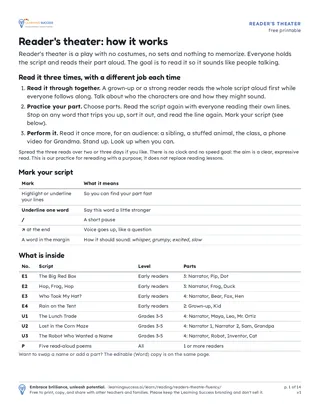
Seven short plays for 2 to 4 readers, at two levels. There are also five poems to read aloud and a one-page how-to.
When to ask for help
Each of these is a reason to ask for help on its own.
- Little change, even with steady practice and good teaching.
- Reading well below what school expects.
- A teacher who raises a concern about reading.
- Extreme upset about reading.
- Complete avoidance of reading.
- Hopelessness about learning.
- Sadness or worry that lasts.
- Significant delays in speech, language or motor development.
- A skill that was there and has gone. Our position is that a lost skill goes to a doctor first, not a tutor.
If no skill has gone, start with the teacher. Say what you are seeing at home, and what you have tried. Beyond the teacher, the right person depends on what it turns out to be about. If the work is too hard, someone who works on that school skill. If worry or mood is the thing, someone who works with children's mental health. In our view, delays in speech, language or movement are worth raising with your child's doctor. In our view, if you are worried enough to ask, a professional evaluation is worth asking about.
Any talk of hurting themselves is a same-day call to your doctor or a crisis line.
Key Takeaways
The ideas on this page are ours. We hold no study of reader's theater, or of poems for reading.
In our view, reread a short script or poem over a few days. Give each read one job.
In our view, let your child hear it read well first. Do not time it.
Do these alongside your child's reading instruction, not in place of it.
Pick a short poem your child can read with a little help. Read it out loud yourself first. Then read it together. Tomorrow, your child can read it alone. This idea is ours. We hold no study of poems for reading. You are not timing anything.
”What to do tonightWhat to use next
A set of questions you answer about what you see at home. A screener is a starting point, not a diagnosis. If your child might need formal accommodations (an IEP or 504 plan), or you suspect a vision, hearing, or medical cause, pursue a professional evaluation too — that's the only route to those supports.
A short reading and spelling practice. Each word appears letter by letter. The picture comes only once the word is complete. So guessing from the image is not available. It includes writing words from memory. That practices the spelling and the writing of a word at the same time.
Common questions from parents
Is there research on reader's theater?
Reader's theater is our practice. The federal early-reading guide we read does not cover it. We hold no study of it. That is a gap in what we hold, not a finding either way. In our view, reader's theater gives rereading a reason. Do it alongside your child's reading instruction, not in place of it.
Why use poems for reading practice?
We hold no study of poems for reading. Using them is our idea. In our view, a short poem is easy to reread. Read it out loud together first. Then your child reads it alone. Do this alongside your child's reading instruction, not in place of it.
Should I time reader's theater practice?
Not for this, in our view. The ideas on this page are ours. We hold no home study that names them. We set no speed goal for them at home. A federal guide for grades 4 to 9 warns against making rereading about speed. Its studies were of help given in school, not at home. Nothing in the guide tests Learning Success.
More in Practice at home
- Air Writing and Sky Writing Letters
- Background Knowledge and Reading Comprehension: What Studies Found
- CVC Word Activities
- Digraphs and Blends: Activities and Practice
- Elkonin Boxes: How to Use Them at Home
- Multisensory Reading Activities
- Phonemic Awareness Activities at Home
- Phonics Activities for Struggling Readers