

Does brain training work for kids who struggle to focus? It’s the question parents type after a note comes home about a new tablet program or a VR headset. The offer sounds hopeful, and you want to say yes.
Your child isn’t broken. Their brain is learning differently, and focus is a skill that gets stronger with practice. That is exactly why it matters what your child practices, and whether the gain follows them back to the page.
TL;DR
- Your child will most likely get better at the program itself. A 2016 review by Simons and colleagues found people improve at the trained tasks, with little evidence the gains reach everyday thinking.
- Before you agree, ask for proof from schoolwork or attention in class. Ask who paid for the study, and what the program replaces in your child’s day.
- Focus grows with practice on the real work. Practice attention on homework itself, in short stretches, with you nearby.
Getting better at the game is real. Whether it shows up in reading, math or class is the question to ask, and the seller should answer it.
“– Laura Lurns
What these programs are good at, and where the evidence stops
A cognitive training program gives your child a task that feels like a game. Hold attention on a target. Remember a sequence. Ignore a distraction. The task gets harder as your child improves, and the scores climb.
That climb is real. Researchers call it near transfer: you get better at what you practiced. The question that matters is far transfer. Does the gain leave the game and show up in reading, in math, or in attention in class?
In 2016, Simons and colleagues published a large review called “Do ‘Brain-Training’ Programs Work?” People got better at the tasks they trained on. The review found little evidence that training improved distantly related tasks or everyday thinking. The same year, the US Federal Trade Commission settled a case over Lumosity ads that promised better performance in school, at work and in athletics. The FTC said Lumosity “simply did not have the science to back up its ads.”
A climbing score also has a second explanation. In one study of adults, Foroughi and colleagues (2016) recruited some people with an ad promising brain training. Others answered a plain ad. Both groups did the same hour of training, and only the first group scored higher on a reasoning test afterward. It was one small study in adults, not children. Still, it shows that a reported gain is sometimes the hope rather than the training. You’ll find more in our summary of the research on attention and expectations.
Why the gains stay in the game, and who sells the program to schools
Practice carries over best to tasks that look like the practice. One research group shows both sides of this. Melby-Lervag, Redick and Hulme (2016) looked at working-memory training. Compared with groups doing another active task, they found no convincing evidence of reliable gains in reading comprehension or arithmetic. Yet Hulme and colleagues (2012) found that training the parts of reading itself, sounds and letters, did reach word reading.
So the same researchers report both results. Training a general ability in the hope that schoolwork improves is the version that has failed again and again. Training the skill itself is the version that reached the skill. Researchers still debate working-memory training, so treat this as a strong pattern, not a closed case.
Attention follows the same pattern. Focus is a skill that gets stronger with practice. The practice that counts is on the thing your child needs to attend to: the page, the problem, the paragraph. A VR headset is the newest wrapper on this same question. The headset is new. The question is not. Does the gain show up in class?
None of this means a school was careless. Schools are sold ed-tech the same way parents are. There is no official certifier for the ESSA evidence tiers, and some sellers hire firms that issue them an “evidence” badge. To a busy district, a badge like that looks official. The honest check is an independent registry, such as the What Works Clearinghouse or Evidence for ESSA, plus one plain question: who paid for the study? Our guide to judging a program’s evidence walks through how to read the answer.
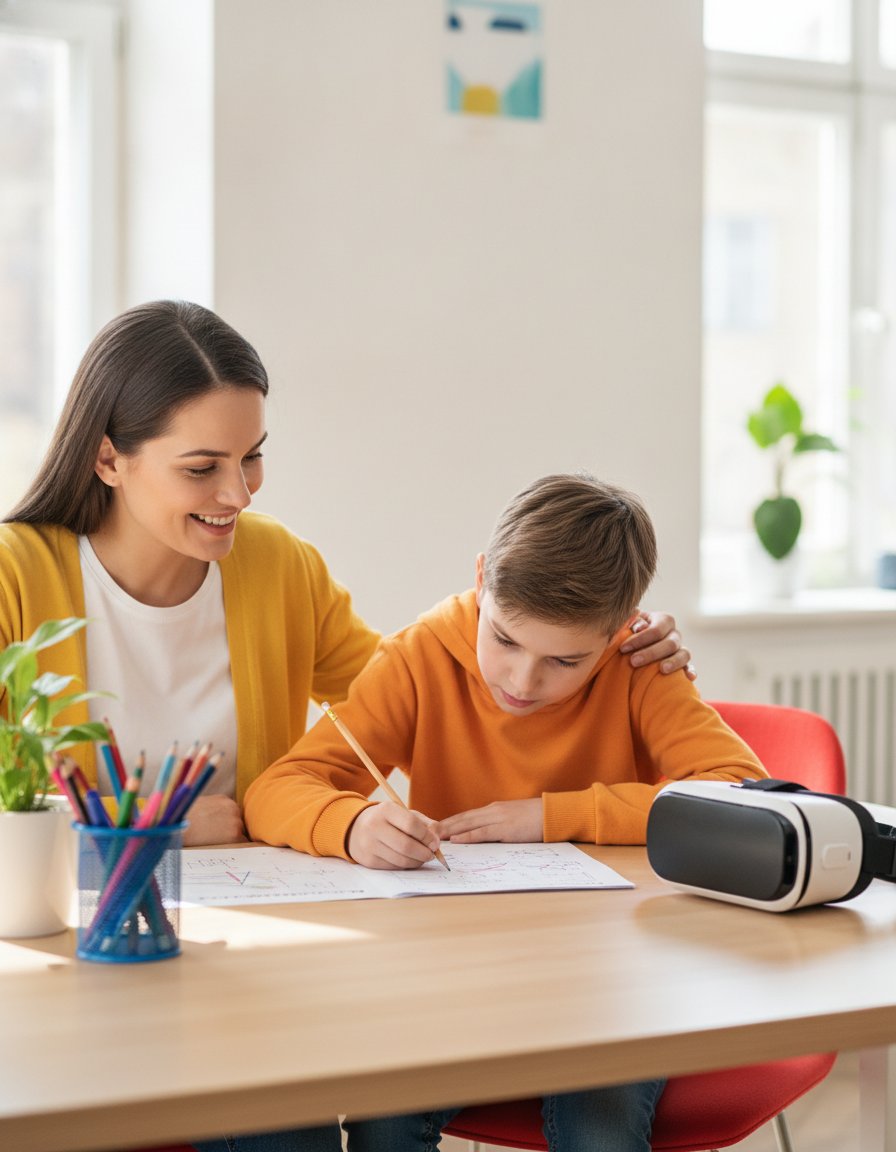
When a school offers a focus program, I ask the parent one thing first: when does your child’s focus fall apart? If it is during reading or math, I look at that skill before anything else. Then we practice attention on the real page, in short stretches, with the parent beside the child. The change I look for is not a score in a game. It is a child who stays with a hard paragraph longer than before.
Key Takeaways
A 2016 review by Simons and colleagues found people get better at the trained tasks, with little evidence the gains reach everyday thinking.
Before you agree, ask for school results, who paid for the study, where the evidence badge came from, and what the program replaces in your child’s day.
Focus is a skill that gets stronger with practice, and the practice that counts is on the real work: the page, the problem, the paragraph.
Nobody will ever advocate for your child as hard as you will. Asking who paid for the study is part of that.
“– Laura Lurns
What to do this week: six questions before you say yes
You do not have to refuse the program. You also do not have to accept it on faith. Ask for a short meeting or send an email this week. Put these questions to the school or the seller.
1. Where did schoolwork improve? Ask for evidence that children’s reading, math or attention in class got better. Scores inside the program do not count.
2. Who ran the study, and who paid for it? Ask whether the comparison group did another active task. Ask whether the people rating attention knew which children had the program.
3. Where did the “evidence-based” label come from? Ask whether it is from an independent registry, or from a firm the seller paid.
4. Were the children in the studies like mine? Ask about their age and about the kind of trouble they had with focus.
5. What does this replace in my child’s day? Our view is that this is the real cost. If the time comes out of reading or math instruction, your child gives up practice on the skills you want to protect.
6. How will we check? Agree before it starts on which piece of schoolwork you will look at, and when you will look again.
While you wait for answers, practice focus on the real work at home. Pick one short stretch of homework, sit beside your child, and stretch the time a little when it goes well. If focus falls apart only during reading or math, check that skill first. A task that is too hard for the skills in place is hard for anyone to stay with.
You want a child who stays with a page of math, not only with a game. Our view is that the villain here is a system, not a teacher. Programs get sold to schools on badges the seller paid for, and children get sorted by labels instead of helped. You are the one who asks the question nobody else asked. Nobody will ever advocate for your child as hard as you will.
When focus is hard, we look at more than focus. The skill underneath, the confidence, holding steps in mind. Our assessment asks about all of them. Start with All Access here.
Common questions from parents
Does brain training help kids who struggle to focus?
Is VR attention training worth it?
What does an “evidence-based” or ESSA badge on a program mean?
My child’s scores in the program went up. Doesn’t that mean it’s working?
What helps focus instead?