
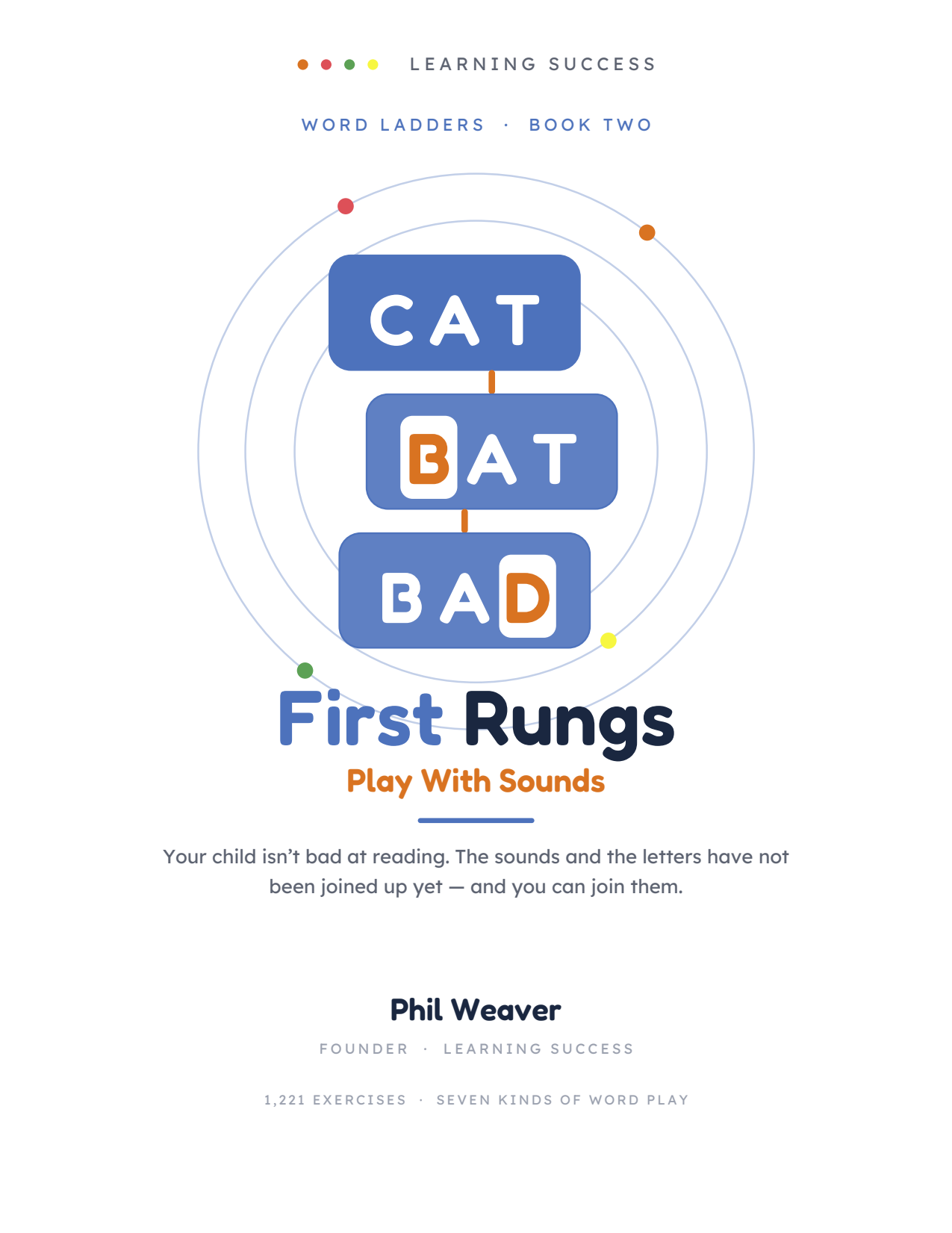
Read-Aloud Phonics Practice for Children Who Find Reading Hard | Over 1,200 Exercises | Ages 5–8
Your child isn’t failing at reading.
The sounds and the letters just haven’t been connected yet — and this book helps you connect them.
Word Ladders: First Rungs – Play With Sounds is the second book in the Read-Aloud Word Ladders series. It was made for children with dyslexia, auditory processing differences, ADHD, or any child the usual school methods haven’t reached yet.
How the exercises work
This book focuses on where a sound sits inside a word, how a word grows when you add a letter and shrinks when you take one away, which words belong in the same family, and what could come next.
You read the prompt. Your child answers out loud. Nothing is written down.
This is intentional. Most word-ladder books ask the child to read the clue and solve it alone — the exact skill that is still hard for this child. Here, the whole activity runs on listening and thinking instead of decoding instructions.
What’s inside
- Where Sounds Sit — first, middle, last
- Grow & Shrink Words — add a letter, take one away
- Think & Connect — predict, rebuild, and sort by rhyme
- A placement page so you start in the right place
- A progress grid to color and an answer shield to cut out
Is this the right stage?
This stage fits a child who knows most letter sounds and can hear that CAT and BAT are different words, but still works hard to blend three sounds into a word and cannot yet reliably read a short word from the page without help.
There is no grade level on the cover on purpose. A child who is working behind a chart does not need that written on the front of their book. The placement page inside helps you choose the right level, and an older child using an earlier stage is not “behind” — they are working where the work actually is.
The coaching that comes with it
This series includes the part most phonics materials skip: how to keep the session calm, why the pause after a question matters, and why naming exactly what the child did works better than “great job.” Ten to fifteen minutes at the table is a full session.
Every book in the series uses the same format and the same voice, so a child can move forward without having to learn a new set of rules.
From Learning Success — fifteen years spent with children who were told they weren’t trying. They were trying.
As an Amazon Associate, Learning Success earns from qualifying purchases