
The Course That Looks Like a Card Game, Because It Is One
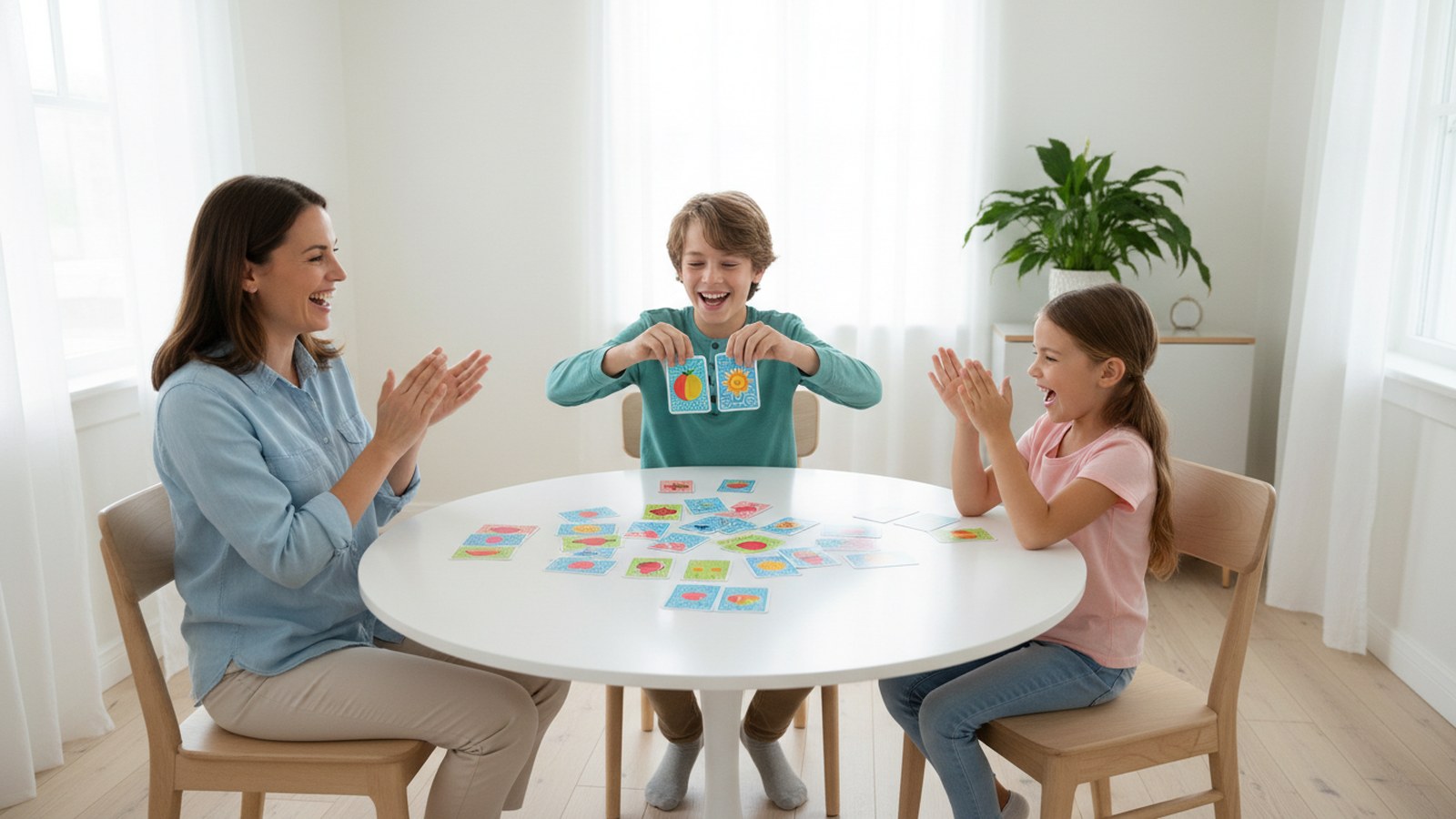
Somewhere in your house is a child who has had enough of screens, enough of worksheets, and more than enough of being the one who struggles. Here’s what we built for that child: a set of memory card games, played with printable cards at a real table, with siblings welcome — where the visual memory practice hides comfortably inside a game a struggling learner can flat-out win.
TL;DR
- Card games that practice visual memory — see it, hold it, find it again — played at a table, together, no screen required once the cards are printed.
- Four sets point the same game at different material: numbers, letters, shapes, and sight words — so the game keeps company with whatever your child is learning elsewhere.
- Included in All Access with every other Learning Success program and your child’s personalized roadmap. Seven days free.
How it works
Every turn runs the same loop: see a card, hold what and where it was, use that hold a few turns later to make the match. That’s visual memory getting genuine reps — and inside a game, a child will run that loop fifty times in a sitting that would be a fight as a worksheet. The grid grows as skills do: more pairs, bigger layouts, rematches on demand.
The four sets — numbers, letters, shapes, sight words — let the game keep company with your child’s other work: letters and sight words alongside reading practice, numbers alongside math work, shapes when you want pure play with nothing school-shaped attached. And it’s deliberately the whole-family course: siblings make it better, grandparents can run it, and twenty minutes at the table is twenty minutes nobody negotiated over.
A child who would fight a worksheet will beg for a rematch. Same practice. Different wrapper.
“– Laura Lurns
What we claim, and what we don’t
Here’s the honesty that most memory-game marketing skips: memory practice reliably improves the game it’s practiced in, and the research on memory training carrying over into reading, writing, or arithmetic is a story of practice staying where it’s practiced. So we won’t tell you this deck will move a report card — the academic skills are built directly, in the courses built for them, all in the same membership.
What this course actually delivers: a real visual memory workout, extra low-pressure time with the letters, numbers, and sight words your child is learning elsewhere, and family play where the child who struggles gets to be the child who’s good at cards. Those are its jobs, and it does them well.
“He HATED [an expensive gamified program]… I have NONE of that with your program.” — Diane Kasterko
“She was doing her homework, without me even asking… it was all done correctly!” — Julie Callison
Individual parents using Learning Success programs, describing their own child in their own words — not a measured result, and not a pattern we claim across families. We publish no aggregate success figures.
The screen-free corner of a complete system
Memory Cards is part of Brain Bloom, included in All Access — along with the 5-Minute Reading Fix for direct reading and spelling practice, Attentive Ear’s listening courses, the visual closure and eye-movement work, number sense courses, and coaching for you at every step. Screen-free options run through the whole catalog, and this course is their charter member.
All Access starts with an assessment — a series of questionnaires about what you’re actually seeing at home, about forty-five minutes, asking across every processing system rather than screening for one suspected thing. Within 48 hours of your finishing, your child’s personalized roadmap arrives as a PDF: which skill to build first, which program builds it, and what follows. It’s yours to keep. (Forty-eight hours is how long the document takes to reach you — not a timeline for your child.)
A screener is a starting point, not a diagnosis. If your child might need formal accommodations (an IEP or 504 plan), or you suspect a vision, hearing, or medical cause, pursue a professional evaluation too — that’s the only route to those supports.
Common questions from parents
Is this really screen-free?
Will memory games improve my child’s schoolwork?
What ages can play?
Do I need a diagnosis before starting?